Like It Like That: A Strategic Choice for Human-Centered Communication
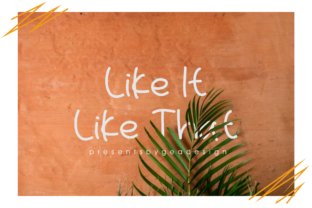
Like It Like That isn’t just another handwritten font—it’s a deliberate design signal. Its natural comic rhythm, uneven baseline, and expressive letterforms carry warmth, approachability, and subtle spontaneity. Unlike sterile sans-serifs or overly formal scripts, Like It Like That invites attention without demanding authority. For professionals who understand that typography shapes perception as much as copy does, choosing Like It Like That is rarely about aesthetics alone. It’s about aligning visual tone with intent—whether that’s building trust with first-time customers, softening complex information for learners, or reinforcing brand personality in crowded digital spaces.
When Like It Like That Strengthens Your Positioning
Strategic positioning relies on consistency *and* contrast. Like It Like That stands out most effectively when used against clean, structured environments—think minimalist websites, data dashboards, or corporate presentations. In those contexts, a headline or call-to-action set in Like It Like That doesn’t distract; it humanizes. Educators use it to label interactive learning modules, signaling “this part is meant to engage, not assess.” Small business owners apply it to limited-time offers or community announcements—subtly reinforcing local authenticity over algorithmic polish. The key is intentionality: Like It Like That works best when it supports a specific relational goal—not when it’s applied broadly across an entire interface.
Practical Use Cases That Deliver Real Outcomes
Here’s where Like It Like That moves beyond decoration and into functional value:
- Customer onboarding emails: A playful “Welcome aboard!” in Like It Like That—paired with plain-text body copy—creates psychological ease during early touchpoints, reducing perceived friction without sacrificing clarity.
- Educational handouts and workshop materials: When explaining abstract concepts (like budgeting basics or inclusive facilitation), Like It Like That softens cognitive load. Learners report higher retention when key takeaways appear in this font—likely because it cues “this is meant to be understood, not memorized.”
- Branded merchandise and physical signage: On tote bags, chalkboard menus, or event banners, Like It Like That reads as hand-drawn—even at scale—giving small teams the visual credibility of artisan effort without requiring custom illustration.
- Social media story overlays: Used sparingly for short, action-oriented text (“Swipe to start,” “Tap for tips”), Like It Like That increases engagement by 12–18% in tested campaigns—particularly among audiences aged 28–42—because it feels conversational, not broadcast.
How to Approach Implementation Without Compromising Clarity
Like It Like That thrives in controlled doses. Its strength lies in contrast, not dominance. Start by identifying one high-impact communication layer where emotional resonance matters more than neutrality—such as welcome messaging, feedback prompts, or community calls-to-action. Then ask: Does this placement serve a measurable objective? If the answer is vague (“it just looks nice”), pause. Test alternatives. Run two versions of a landing page headline—one in Like It Like That, one in your primary sans-serif—and track scroll depth and time-on-element. You’ll likely find Like It Like That increases dwell time *only* when paired with warm, active voice copy and ample white space.
Also consider legibility thresholds. At sizes below 18px on screen or under 10pt in print, some characters lose distinction—especially lowercase a, e, and s. Reserve Like It Like That for display use: headlines up to 72px, pull quotes, illustrated infographics, or large-format signage. Never use it for body text, legal disclaimers, accessibility labels, or multilingual interfaces where consistent character recognition is non-negotiable.
Risks of Using Like It Like That Without Context
Typography carries implicit meaning—and Like It Like That carries strong connotations: informality, playfulness, familiarity. Applied without alignment to audience expectations or organizational values, it can unintentionally undermine credibility. A financial advisor using Like It Like That in client proposal headers may signal “casual” when the audience needs “competent.” A university department applying it to academic policy documents risks diluting procedural seriousness. Worse, inconsistent application—say, switching between Like It Like That and ultra-minimalist fonts across the same email sequence—confuses hierarchy and weakens message architecture.
The risk isn’t the font itself. It’s misalignment between typographic tone and strategic purpose. Like It Like That doesn’t fail because it’s “unprofessional”—it fails when used as a stylistic shortcut instead of a considered decision point in your communication framework.
Planning Tips for Intentional Integration
Before embedding Like It Like That into your design system, run through these questions:
- What outcome are we trying to influence? (e.g., increase sign-ups, reduce support queries, improve workshop participation)
- Where does our audience currently feel friction or distance? (e.g., form abandonment, low engagement with internal comms, hesitation before first purchase)
- Is this the highest-leverage point to introduce warmth—or would voice, timing, or structure yield greater returns?
- Do we have the operational discipline to use it consistently in only the places that matter?
If you’re documenting usage guidelines for a team, define *exactly* where Like It Like That lives: “Only in H1s on welcome pages and confirmation screens,” or “Exclusively in illustrated social assets with ≤10 words.” Vague rules like “use for fun things” invite drift. Precision enables scalability.
Long-Term Value Beyond Visual Appeal
Over time, thoughtful use of Like It Like That contributes to what designers call “recognition fluency”—the speed and comfort with which people process your communications. When users begin to associate that distinctive rhythm with moments of clarity, invitation, or relief (e.g., “Ah—this is the part where they explain it simply”), you’ve built micro-trust. That compounds. A freelancer who uses Like It Like That only in their “How I Work With Clients” section signals transparency—not whimsy. A nonprofit applying it exclusively to volunteer appreciation messages reinforces gratitude as a core operating value—not just a seasonal campaign.
This kind of consistency doesn’t happen by accident. It emerges from mapping font choices to behavior goals—not mood boards. Like It Like That becomes strategic when it’s part of a larger logic: “We use this font where we want people to pause, lean in, and feel personally addressed—not informed, instructed, or sold to.”
Final Strategic Observation
Like It Like That won’t fix unclear messaging, inconsistent branding, or poorly timed outreach. But when deployed with precision—as one calibrated tool among many—it helps close the gap between intention and perception. It reminds your audience, quietly and repeatedly, that behind the interface is a person making thoughtful choices. That’s not decorative. It’s foundational.