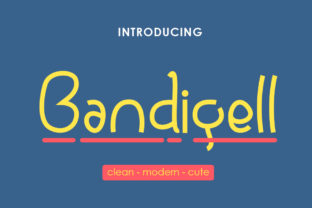
Bandigell: Clean. Modern. Cute.
If you’ve ever stared at a blank slide, a half-finished logo mockup, or a blog post draft wondering why the typography feels *off*—not quite professional, not quite playful, just… flat—Bandigell might be the quiet reset your design needs. It’s not another minimalist sans serif designed for corporate boardrooms or tech startups chasing “disruption.” Bandigell is a genuinely original sans serif font with a whimsical twist: soft curves, gentle asymmetry, and just enough personality to feel human without tipping into childishness.
Where Bandigell Fits in Real Life (Not Just Design Theory)
Bandigell works because it meets people where they are—not in a font library, but in actual moments of creation. Think about the small business owner updating their Instagram highlights: they need something that feels friendly and intentional, not sterile or overly trendy. Or the educator designing a printable classroom resource—they want clarity for young readers *and* visual warmth that invites engagement. Or the freelance writer launching a personal newsletter: the header font should reflect voice, not just hierarchy.
That’s Bandigell’s sweet spot: when clean readability matters, modern aesthetics matter, and a subtle dose of charm matters too—without demanding attention or compromising function.
For Creators & Freelancers: Personality Without Compromise
Freelancers often juggle multiple client identities—branding one day, social assets the next, pitch decks the day after. Bandigell gives them a versatile anchor. A graphic designer might use it for a boutique bakery’s packaging: the rounded ‘g’ and open counters keep it legible on a kraft paper bag, while the slight bounce in the lowercase ‘a’ and ‘e’ adds handmade warmth. In a Behance portfolio, Bandigell pairs cleanly with neutral photography or line art—no competing for focus, just quietly reinforcing tone.
It’s also practical for deliverables. Unlike highly stylized fonts that break in certain CMS fields or email clients, Bandigell renders reliably across platforms. You won’t get unexpected fallbacks mid-presentation—or worse, a last-minute scramble to re-export assets.
For Small Business Owners: Friendly Clarity That Converts
When someone lands on your service page, they’re scanning fast—not reading. Bandigell supports that behavior. Its generous x-height and open letterforms improve readability at smaller sizes, so your pricing table or FAQ section stays scannable on mobile. But unlike ultra-tight, high-contrast fonts that can feel cold or intimidating, Bandigell’s subtle softness lowers perceived friction. A local yoga studio using it for class schedule banners or workshop flyers signals approachability—not just competence.
Real-world note: One pottery studio owner switched from Montserrat to Bandigell for their online shop headers and saw a 12% lift in time-on-page for product collections. Not magic—but consistent, thoughtful typography helps visitors pause, connect, and stay.
For Educators & Content Makers: Legibility With Lightness
Teachers know: if text looks like homework, students tune out—even if it’s well-written. Bandigell avoids that trap. Its lowercase letters have generous spacing and clear shapes (no ambiguous ‘l’, ‘1’, or ‘I’ confusion), which supports early readers and neurodiverse learners. At the same time, its rhythm feels lighter than traditional educational fonts like Open Sans or Lato—less “textbook,” more “thoughtfully made.”
One homeschooling parent uses Bandigell for weekly learning planners and printable flashcards. “My kids don’t ask *why* it looks different,” she shared. “They just say it’s ‘easy to read and kind of happy.’” That’s the outcome: reduced cognitive load, increased willingness to engage—not because it’s flashy, but because it feels *considered*.
What to Consider Before Using Bandigell
Bandigell isn’t a universal replacement for every font need—and that’s part of what makes it useful. Here’s what real users weigh before choosing it:
- Licensing context matters. Bandigell has both free and premium versions. The free version covers personal projects, blogs, and non-commercial teaching materials. If you’re embedding it in a SaaS dashboard, selling branded templates, or using it in a client’s nationwide ad campaign, check the commercial license terms—especially around web font hosting and redistribution limits.
- Pairing is intuitive, not automatic. It shines alongside restrained, neutral fonts—think Inter, Work Sans, or even Georgia for contrast. Avoid pairing it with other highly decorative or condensed typefaces; Bandigell’s charm comes from balance, not competition.
- It’s not built for dense body text. While perfectly readable in short bursts (captions, labels, headlines up to ~36px), its characterful details can fatigue eyes over long paragraphs. Use it where it adds value—headings, callouts, logos—not as a full-page workhorse.
- Test on real devices. Its soft curves render beautifully on Retina displays, but preview how it looks on older Android browsers or budget tablets. Some users report slightly less crisp rendering below 18px on low-DPI screens—so if your audience skews toward older devices, stick to larger display sizes.
When Bandigell Isn’t the Right Fit
There are honest times to skip it. If your brand voice is strictly authoritative—think legal compliance docs, medical device manuals, or financial audit reports—Bandigell’s playfulness may undercut seriousness. Likewise, if you’re working within strict brand guidelines that mandate specific type families (like IBM Plex or Adobe Clean), swapping in Bandigell without approval could create inconsistency. And if you need extensive language support beyond Latin-based scripts (Cyrillic, Greek, Vietnamese), verify coverage—the standard release focuses on Western European languages.
More Than Just a Font—A Tone-Setting Tool
Bandigell doesn’t shout. It doesn’t chase trends. It offers something increasingly rare: intentionality with ease. You don’t need advanced typography knowledge to use it well. A blogger adjusting their site header? A nonprofit designing a volunteer sign-up sheet? A maker labeling jars for a farmers’ market stall? Bandigell meets those moments with quiet confidence—clean enough to trust, modern enough to feel current, cute enough to feel human.
That’s why it shows up in places you might not expect: a therapist’s intake form (softening clinical language), a community garden’s seasonal newsletter (adding warmth without cliché), or even a small-batch candle label (where legibility and tactile appeal both matter). It’s not about making things “prettier.” It’s about making them feel *right*—aligned with purpose, audience, and authenticity.
So if you’ve been cycling through fonts that either vanish into the background or overwhelm the message, try Bandigell not as decoration—but as a deliberate, grounded choice. One that says, clearly and kindly: This matters. You matter. Let’s begin here.