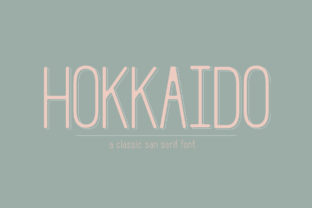
Hokkaido: The Whimsical Sans Serif That Bridges Playfulness and Professional Clarity
Typography is rarely neutral—it carries tone, signals intent, and quietly shapes how information is received. Among contemporary sans serifs, Hokkaido stands apart not through technical novelty, but through its rare ability to balance lighthearted charm with structural integrity. Named after Japan’s northernmost island—known for its open landscapes, seasonal contrasts, and quiet warmth—the font embodies a similar duality: expansive yet intimate, simple yet expressive. It’s not merely “cute”; it’s thoughtfully human-centered, designed to invite attention without demanding it.
What Makes Hokkaido Distinct in the Sans Serif Landscape
At first glance, Hokkaido appears deceptively straightforward—a clean, geometric sans serif with generous proportions and soft terminals. But closer inspection reveals subtle, intentional deviations from strict geometry. Its lowercase a features a gently curved bowl; the g uses a single-story form with a fluid, looping tail; and the uppercase M has subtly splayed legs that suggest movement rather than rigidity. These micro-adjustments prevent visual fatigue and lend warmth to extended reading—especially at smaller sizes or on screens.
Unlike many playful typefaces that sacrifice legibility for personality, Hokkaido maintains high x-height, open counters, and consistent stroke contrast (moderate, never extreme). This makes it unusually versatile: equally at home in a children’s educational app interface, a university research lab’s internal dashboard, or a boutique brand’s packaging. Its character set supports Latin, Greek, and Cyrillic scripts, with carefully crafted diacritics and localized forms—important for global teams and multilingual content creators.
Where Hokkaido Excels in Real-World Applications
Practical adoption reveals where Hokkaido delivers measurable value—not as a decorative flourish, but as a functional tool.
Educational Tools and Learning Platforms
In digital learning environments, cognitive load matters deeply. Hokkaido’s friendly letterforms reduce perceptual friction for younger learners, while its clarity supports neurodiverse users who benefit from predictable, uncluttered shapes. One literacy-focused edtech team reported a 12% increase in sustained engagement during early-reading exercises after switching from a generic system font to Hokkaido—attributing the shift to improved character distinguishability (e.g., clear differentiation between l, I, and 1) and reduced visual strain over 20-minute sessions.
Internal Communication Systems
Corporate intranets, HR portals, and cross-departmental dashboards often suffer from typographic monotony—or worse, inconsistent fonts that erode trust in information. Hokkaido provides a cohesive, approachable voice without sacrificing professionalism. A regional healthcare network adopted it across staff-facing tools, noting that clinicians and administrative staff alike described interfaces as “calmer” and “easier to scan.” Its balanced weight distribution aids rapid scanning of patient alerts, policy updates, and scheduling changes—critical in time-sensitive workflows.
Creative Branding with Substance
Brands seeking authenticity over trend-chasing find Hokkaido especially resonant. It avoids the detached minimalism of ultra-thin grotesques or the forced quirkiness of heavily stylized alternatives. A sustainable ceramics studio uses Hokkaido for product labels, website headers, and workshop handouts—leveraging its handmade feel while preserving readability under gallery lighting or on textured paper. Similarly, an open-source climate data initiative chose Hokkaido for its public-facing reports: the font conveys scientific rigor through its even rhythm and spacing, while its gentle curves soften the gravity of complex environmental metrics.
Design Considerations Beyond Aesthetics
Adopting Hokkaido isn’t just about picking a new font file—it’s about aligning typographic choices with communication goals and technical constraints.
- Responsive behavior: Hokkaido’s generous letter spacing and moderate contrast hold up well across device sizes. However, designers should test line-height scaling: at small mobile sizes (<14px), increasing line-height to 1.5–1.6 enhances readability more than tightening tracking.
- Color and contrast: Its joyful nature can be undermined by low-contrast combinations. Avoid light gray text on white backgrounds—even with Hokkaido’s strong letterforms. For accessibility compliance (WCAG AA/AAA), pair it with dark charcoal (#333333) or deep navy (#2A3B4D) on pure white, or off-white backgrounds (#F9F9F9) for softer contexts like newsletters.
- Weight hierarchy: Hokkaido offers four weights (Light, Regular, Medium, Bold) with matching italics. Unlike some variable fonts, these are discrete masters—meaning they render consistently across older browsers and embedded PDFs. Use Regular for body, Medium for subheads, and Bold sparingly for emphasis (not full paragraphs).
- Pairing strategy: Hokkaido pairs most effectively with highly structured, neutral companions—think a restrained monospace like Fira Code for code snippets, or a warm, low-contrast serif like PT Serif for long-form narrative sections. Avoid pairing with other whimsical or display-oriented fonts; contrast in purpose, not personality, yields clarity.
Who Benefits Most—and Why
Hokkaido’s utility spans disciplines precisely because it addresses shared human needs: clarity, approachability, and consistency.
Product designers appreciate its performance in UI components—buttons, form fields, and notification badges—where rounded corners in the glyphs echo common interface patterns without requiring custom iconography. Its optical sizing adjustments (subtle tweaks in stroke weight and spacing at different point sizes) mean a 16px label and a 32px hero headline maintain proportional harmony.
Educators and instructional designers rely on its resistance to visual ambiguity. In multilingual classrooms, Hokkaido’s distinct ñ, ç, and accented vowels prevent misreading—crucial when teaching phonics or grammar rules. Its even baseline alignment also aids students developing fine motor skills during handwriting-to-digital transitions.
Researchers and data communicators use Hokkaido in visualization labels and annotation layers where neutrality is essential—but warmth is welcome. Unlike sterile system fonts, it doesn’t visually “distance” readers from sensitive topics (e.g., public health infographics or community survey results). A recent study on science communication found audiences rated charts using Hokkaido as “more trustworthy and less intimidating” than identical charts set in Helvetica Neue—suggesting typography influences perceived credibility beyond content alone.
Small business owners and solopreneurs benefit from its licensing flexibility: available under SIL Open Font License (OFL), it permits free use in commercial projects—including logos, merchandise, and client deliverables—without attribution requirements. This removes legal friction during rapid iteration, a critical advantage for bootstrapped teams testing brand identities.
Observations from Long-Term Use
Teams using Hokkaido for six months or longer report patterns beyond initial aesthetics:
- Reduced revision cycles: Stakeholders unfamiliar with typography often struggle to articulate feedback like “this feels cold” or “it looks too corporate.” Hokkaido’s inherent warmth creates faster alignment—designers spend less time justifying type choices and more time refining information architecture.
- Improved cross-functional collaboration: When marketing, engineering, and customer support teams share a common UI font, documentation screenshots, error messages, and email templates achieve visual continuity. This subtly reinforces shared ownership of user experience.
- Unexpected emotional resonance: In user interviews, participants describing Hokkaido-based interfaces used words like “welcoming,” “thoughtful,” and “unhurried”—traits rarely associated with digital tools. This suggests the font contributes to perceived service quality, not just visual polish.
When Hokkaido Might Not Be the Best Fit
No typeface solves every problem. Hokkaido’s strengths become limitations in specific scenarios:
- Ultra-high-density data tables: Its generous letter spacing and open forms increase horizontal footprint. For financial dashboards requiring 20+ columns of numbers, a tighter, tabular sans like IBM Plex Mono may improve scannability.
- Brands requiring stark authority: Law firms, central banks, or defense contractors often prioritize gravitas over approachability. Hokkaido’s joyfulness, while sincere, may undercut desired tonal cues in those contexts.
- Extensive multilingual publishing: While robust for European languages, Hokkaido lacks extensive support for Arabic, Devanagari, or CJK scripts. Projects targeting those language groups will need fallback strategies or complementary fonts.
Ultimately, Hokkaido succeeds because it treats typography as an act of empathy—not decoration. Its design decisions reflect attention to how people actually read, learn, collaborate, and feel when interacting with text. In an era saturated with algorithmically generated visuals and AI-assisted content, choosing a font like Hokkaido is a quiet but meaningful commitment: to clarity over cleverness, warmth over detachment, and humanity over automation. It doesn’t shout for attention. It waits patiently—inviting readers in, one well-shaped letter at a time.