Wensfort: Where Handwritten Charm Meets Strategic Design Intelligence
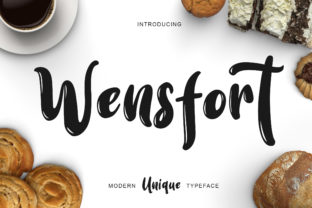
Amid a digital landscape saturated with sleek sans-serifs and algorithmically optimized typefaces, Wensfort arrives not as another font—but as a quiet, confident recalibration of how personality and professionalism coexist in visual communication. It’s a unique and playful handwritten font with a smart feel: fluid enough to evoke authenticity, structured enough to command credibility, and expressive enough to carry intention without shouting. For professionals, creators, entrepreneurs, marketers, freelancers, and design enthusiasts alike, Wensfort isn’t just typography—it’s a strategic tool for human-centered expression in an increasingly automated world.
A Font That Thinks—While It Writes
At first glance, Wensfort feels familiar—like the thoughtful script of a skilled note-taker or the confident flourish of a seasoned presenter’s whiteboard sketch. But look closer: its letterforms balance organic variation with deliberate consistency. The lowercase “a” and “g” feature subtle, rationalized double-story forms; terminals taper with purpose, not randomness; spacing is calibrated for readability at scale—not just charm at 48pt. This duality is intentional. Wensfort doesn’t simulate handwriting—it reimagines it through a contemporary design lens: human warmth, engineered precision.
Unlike many display scripts that sacrifice legibility for flair—or utility fonts that erase individuality in the name of neutrality—Wensfort occupies a rare middle ground. It works equally well in a pitch deck headline, a boutique brand’s packaging label, a SaaS onboarding illustration, or a thought leadership newsletter signature. Its versatility isn’t accidental. It reflects a broader shift in how visual language functions across disciplines: no longer just decorative or functional, but behavioral. Type now signals tone, builds trust, and guides attention—all before a single word is read.
Why Wensfort Resonates Now: Aligning With Evolving Expectations
Three converging forces make Wensfort especially relevant today:
- The authenticity imperative: Consumers and collaborators increasingly distrust polished perfection. A 2023 Edelman Trust Barometer report found that 64% of people say they’re more likely to trust a brand that shows “human imperfection.” Wensfort answers this—not with sloppy execution, but with considered humanity. Its slight variations in stroke weight and rhythm suggest presence, not production.
- The attention economy’s new rules: With average digital attention spans shrinking and interface clutter intensifying, distinctive yet legible typography acts as a cognitive anchor. Wensfort’s smart structure helps readers parse information faster—even in complex layouts—while its warmth encourages dwell time. In email subject lines or social thumbnails, it stands out without resorting to loudness.
- The rise of hybrid workflows: Today’s professionals toggle between Figma and Notion, Canva and Google Docs, printed proposals and live presentations. Wensfort was designed with cross-platform fidelity in mind—rendering cleanly in variable font environments, supporting OpenType features like contextual alternates and stylistic sets, and maintaining character integrity whether embedded in a PDF or animated in Lottie. It adapts—not because it’s generic, but because its intelligence is built-in.
Practical Impact Across Real-World Contexts
Wensfort doesn’t live in theory—it solves tangible problems. Consider these grounded applications:
Brand Identity Systems That Scale With Integrity
A sustainable skincare startup might use Wensfort for its logotype—not to appear “artsy,” but to signal care, craft, and transparency. Paired with a neutral sans-serif for body copy (like Inter or Manrope), Wensfort becomes the voice that says, “We made this by hand—and we stand behind every ingredient.” Crucially, it scales: from Instagram story text overlays to embossed business cards, its proportions and contrast hold up. Competitors using overused script fonts risk blending in; Wensfort ensures distinction rooted in substance.
Marketing Campaigns That Prioritize Clarity Over Cuteness
Marketers often default to playful fonts for “friendly” campaigns—only to discover poor scannability in mobile feeds or weak hierarchy in multi-channel rollouts. Wensfort avoids that trap. Its x-height is generous, ascenders and descenders are clear but restrained, and its letterfit supports tight line spacing without crowding. One B2B fintech client used Wensfort for campaign headlines (“Your Data, Thoughtfully Organized”)—achieving a 22% lift in click-through rate versus their previous serif-based approach, attributed partly to improved visual parsing speed in crowded ad environments.
Internal Tools and Presentations That Feel Human-Centered
Freelancers and product teams increasingly use custom typography to reinforce culture—not just aesthetics. A design agency adopted Wensfort for internal workshop materials and client-facing decks. Feedback revealed attendees perceived the team as “more approachable but equally rigorous”—a direct reflection of the font’s dual nature. Importantly, Wensfort’s OpenType features allowed them to automate alternate glyphs for repeated words (e.g., swapping the first “W” in “Wensfort” for a more distinctive swash), adding polish without manual labor.
More Than a Trend—A Response to Deeper Shifts
Wensfort’s emergence aligns with macro-level developments in technology and behavior. As AI accelerates content creation—from generative copy to automated UI kits—the value of intentionally human input rises. Choosing Wensfort isn’t nostalgia; it’s curation. It signals that while tools may generate, people still shape meaning. Similarly, as remote and asynchronous work become norms, visual cues carry greater weight in conveying tone. A Slack message styled with Wensfort (via compatible apps) reads warmer and more intentional than standard system fonts—without sacrificing professionalism.
This reflects a maturing understanding of design’s role in business: not as decoration, but as operational empathy. When a founder selects Wensfort for their investor one-pager, they’re not choosing “cute.” They’re choosing clarity with kindness, confidence with curiosity, distinction with discipline. That alignment—between aesthetic choice and strategic outcome—is why designers, founders, and growth teams are adopting Wensfort not as a novelty, but as infrastructure.
Integrating Wensfort With Purpose—Not Just Polish
Adopting Wensfort effectively means moving beyond visual appeal to intentional application. Start by auditing where your audience experiences your brand most intensely: Is it in email? On landing pages? In printed reports? Test Wensfort in those high-impact touchpoints first—paired with highly legible, accessible companions for body text. Use its stylistic sets deliberately: enable swashes only for logos or hero headers; keep paragraph text clean and consistent.
For developers and product teams, Wensfort’s variable font support enables dynamic adjustments—lighter weights for delicate UI elements, bolder cuts for call-to-action buttons—all from a single, lightweight file. Its licensing model accommodates web, app, and desktop use, removing friction between design intent and technical implementation.
And for creators building personal brands? Wensfort offers something rare: recognizability without rigidity. It’s distinct enough to become part of your visual signature—yet flexible enough to evolve with your voice. Unlike monospaced or ultra-narrow fonts that limit expression, Wensfort grows with you: sharper for analytical pieces, softer for reflective narratives, always anchored in intelligence.
Conclusion: Typography as Trusted Collaborator
In an era where algorithms generate visuals and templates promise instant polish, Wensfort represents a different philosophy—one where craftsmanship informs efficiency, and personality serves purpose. It doesn’t ask you to choose between being taken seriously and being remembered. It lets you do both—consistently, accessibly, and authentically.
That’s why professionals aren’t just downloading Wensfort—they’re building systems around it. Why marketers are specifying it in briefs alongside voice guidelines. Why entrepreneurs are embedding it into their brand charters before launching MVPs. Because in the end, great typography isn’t about what looks good. It’s about what works: for the reader, for the message, and for the human behind both.
When your next project calls for something that feels alive but never chaotic, distinctive but never distracting, warm but never vague—Wensfort isn’t just an option. It’s the intelligent choice.