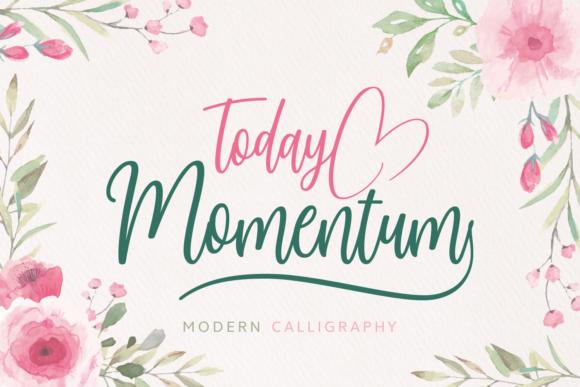
Today Momentum: Handwritten Elegance for Real Creative Work
Today Momentum isn’t just another script font—it’s a quiet confidence in type form. With its gentle, flowing strokes and subtle variations in line weight, it feels like ink laid down by a practiced hand: warm, intentional, and unhurried. There’s no forced flair or exaggerated swash—just sincerity, rhythm, and a delicate charm that reads as both sophisticated and deeply human. If you’ve ever scrolled past a wedding invitation, boutique packaging, or an artisanal café menu and paused because the typography *felt* right—that’s the space Today Momentum lives in.
Where Today Momentum Fits Naturally (and Why It Stands Out)
Fonts don’t exist in isolation—they live inside context. Today Momentum shines brightest where authenticity matters more than authority, and warmth matters more than width. Here’s where real people are already using it—not as decoration, but as deliberate tone-setting:
- Small-Business Branding: A ceramicist launching her online shop chose Today Momentum for her logo and product tags. Not for “cuteness,” but because it quietly signals craftsmanship, care, and personal attention—qualities customers actively seek when buying handmade goods. It pairs effortlessly with clean sans-serifs (like Inter or Lato) for balance: Today Momentum handles the voice; the sans-serif handles the structure.
- Wedding & Event Design: Couples skip generic calligraphy fonts because they want something that feels like *them*, not a template. Today Momentum’s relaxed baseline and soft entry/exit strokes lend themselves beautifully to names on invitations, menu cards, or signage—especially when printed on textured cotton paper or letterpress. One planner noted it “reduces the stiffness of formal events without losing reverence.”
- Digital Content That Breathes: Blog headers, Instagram story quotes, or Substack newsletter banners gain quiet distinction with Today Momentum. Unlike bolder scripts that dominate or distract, it invites pause—not shout. A wellness coach uses it sparingly for weekly reflection prompts (“What moved you this week?”), letting the font’s gentle cadence reinforce her message’s intentionality.
- Editorial & Publishing Touches: Independent magazines and literary journals use Today Momentum for pull quotes, chapter dividers, or author bios—not full body text, but strategic moments where personality should surface. Its legibility at 18–24pt makes it reliable for print and high-res digital displays, unlike many ultra-thin handwritten fonts that vanish on screens.
Who Benefits—and How Their Needs Shape Use
It’s not about who “should” use Today Momentum—it’s about who finds their goals supported by its character. A freelance designer working with local makers might reach for it to reinforce brand intimacy. A teacher crafting classroom posters may choose it to soften academic content and invite engagement. A nonprofit writing donor thank-you notes might apply it to handwritten-style digital signatures—making automated outreach feel personally penned.
Even developers find utility: Today Momentum works well with modern web font loading strategies (WOFF2, `font-display: swap`) and renders cleanly across browsers when paired with fallbacks. It’s not built for code editors or data dashboards—but it *is* built for the human-facing layers those systems support.
Practical Considerations Before You Apply It
Like any tool with personality, Today Momentum rewards thoughtful application—not default selection. Here’s what users consistently notice after a few projects:
- Size matters more than expected: At under 16pt, letterforms begin to lose clarity, especially on lower-resolution screens or in email clients. Reserve it for headlines, short labels, or decorative accents—not paragraph text or mobile navigation.
- Contrast is your co-pilot: Today Momentum thrives beside typefaces with strong x-heights and open counters (think Open Sans, Source Serif Pro, or even Roboto). Avoid pairing it with other delicate scripts or overly geometric sans-serifs—the contrast creates breathing room and visual hierarchy.
- Color choice changes its mood: In charcoal gray on ivory paper, it reads classic and grounded. In deep navy on cream, it feels quietly luxurious. But in bright neon or thin light gray on white? It risks looking tentative or washed out. Test in real context—not just mockups.
- Licensing is straightforward—but verify your use case: The standard license covers desktop, web, and app embedding for most small-to-midsize projects. If you’re building a SaaS dashboard where Today Momentum appears in user-generated content (e.g., customizable report headers), double-check extended licensing terms. Most users won’t need it—but clarity upfront saves time later.
Strengths That Solve Real Problems
Today Momentum doesn’t try to be everything. Its strengths are specific—and precisely why it solves everyday creative challenges:
- It adds perceived value without adding complexity: A coffee roaster switched from a free brush script to Today Momentum for their limited-edition bag labels. No redesign, no new photography—just type. Customers reported the product “felt more considered,” and wholesale buyers cited “stronger shelf presence.”
- It bridges digital and physical seamlessly: Because its outlines are carefully hinted and its spacing optimized for both screen and print, a single font file serves social graphics, PDF lookbooks, and foil-stamped business cards—no redesign gymnastics required.
- It avoids trend fatigue: Unlike fonts built around current aesthetics (glitch, vaporwave, ultra-minimal), Today Momentum draws from timeless handwriting principles: variation, rhythm, and restraint. It hasn’t aged since release—and likely won’t for years.
A Note on What It Doesn’t Do (and Why That’s Okay)
Today Momentum isn’t meant for dense UI labels, multilingual interfaces with complex diacritics, or environments demanding maximum legibility at a glance (think airport signage or medical dashboards). It doesn’t include stylistic alternates, ligatures, or extensive language support beyond Latin-based scripts. That’s not a gap—it’s focus. When your goal is to evoke calm attention, not convey urgent information, narrowing scope is a strength, not a limitation.
One graphic designer put it plainly: “I don’t use Today Momentum when I need to explain something. I use it when I want someone to *feel* something first—and understand it deeper because of that feeling.”
Getting Started Without Overthinking It
You don’t need a branding audit to test Today Momentum. Try it in one low-stakes place this week: rewrite your email signature in it (with a simple sans-serif fallback), drop it into a Canva social post headline, or apply it to a single section of your portfolio site. Notice how it shifts tone—not just appearance. Does it make the message feel more personal? More grounded? More like *you*?
That’s the quiet power of Today Momentum: it doesn’t shout for attention. It earns it—slowly, steadily, and with unmistakable grace.