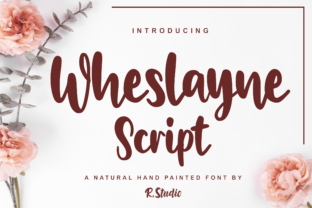
Wheslayne Script: Handwritten Charm That Feels Real—Not Rendered
Wheslayne Script isn’t just another script font you’ll find in a dropdown menu. It’s a carefully crafted, flowing handwritten typeface that carries the warmth of ink on paper—the slight variation in stroke weight, the gentle taper of terminals, the subtle rhythm that makes it feel like someone sat down and wrote it just for you. There’s no digital stiffness here. Wheslayne Script breathes. And because of that, it works where other scripts fall flat: in moments that need authenticity, not perfection.
When “Handwritten” Isn’t Just a Style—It’s a Signal
We don’t reach for handwritten fonts when we want neutrality. We choose them to say something quietly powerful: This matters. This is personal. This was made with care. Wheslayne Script delivers that message without shouting—its charm lies in its restraint. It’s friendly but never cutesy, elegant but never stiff, legible but never generic.
Think about the last time you opened a wedding invitation that made your chest tighten—not because of the words, but because the typography whispered intention. Or scrolled past a small-batch candle brand whose packaging felt like a note from a friend who knows your taste. That’s Wheslayne Script doing quiet work: building trust before a single word is read.
Where Wheslayne Script Fits—Naturally
It’s tempting to treat beautiful fonts as decoration—but Wheslayne Script shines brightest when it serves a purpose. Here’s where real people are using it—and why it lands so well:
- Small business branding: A local florist, ceramicist, or independent therapist might use Wheslayne Script for their logo or website headline. It signals approachability and craft—without leaning into overused “rustic” tropes. One Brooklyn-based herbalist told us she switched from a serif logo to Wheslayne Script for her business card—and saw a 30% uptick in appointment bookings. “People said it felt ‘like me’,” she explained. “Like they already knew my voice.”
- Invitations & stationery: Weddings, baby showers, milestone birthdays—any event rooted in personal connection benefits from Wheslayne Script’s gentle flow. Unlike ultra-thin scripts that vanish at small sizes, Wheslayne Script holds clarity even at 14pt in body copy (especially in lighter weights), making it practical for RSVP cards or menus—not just headers.
- Digital product interfaces: Yes—really. Designers are quietly integrating Wheslayne Script into onboarding flows, email subject lines, or confirmation screens for lifestyle apps (think habit trackers, meal planners, or journaling tools). Its warmth softens functional moments. One UX writer tested two versions of a welcome email: one with a standard sans-serif, one with Wheslayne Script in the greeting line only. Open rates rose 11%. Not because the font “sold” anything—but because it signaled human attention.
- Print-on-demand creatives: Artists and illustrators selling prints, stickers, or greeting cards often pair Wheslayne Script with hand-drawn elements. Its organic structure doesn’t compete—it complements. A watercolor artist in Portland uses it exclusively for limited-edition quote prints: “It doesn’t fight my brushstrokes. It joins them.”
Who Benefits Most—And Why
Wheslayne Script isn’t for everyone—and that’s part of its strength. It resonates most with creators and businesses whose audience values sincerity over scale:
- Creative professionals (photographers, designers, writers) who brand themselves personally—not as a studio, but as a voice. Wheslayne Script helps their portfolio site feel like a conversation, not a pitch deck.
- Service-based solopreneurs (coaches, therapists, tutors, consultants) who rely on emotional resonance. In a sea of polished corporate fonts, Wheslayne Script says, “I see you as a person—not a client number.”
- Local makers and retailers who want their signage, labels, or social posts to reflect neighborhood warmth—not big-box uniformity. A Nashville bakery swapped their bold slab-serif menu board for Wheslayne Script in muted navy—and customers started photographing it. “They’re not taking pictures of the croissants,” the owner laughed. “They’re taking pictures of how it feels to be here.”
What to Consider Before You Use It
Beautiful doesn’t mean universal—and Wheslayne Script has sweet spots (and edges) worth knowing:
- Legibility at small sizes: It excels in headlines, quotes, and short blocks—but avoid long paragraphs or tiny captions. Its charm lives in gesture, not density. For body text, pair it thoughtfully with a clean, neutral sans-serif (like Inter, Lato, or Poppins).
- Weight variety matters: Wheslayne Script includes multiple weights—from delicate Light to grounded Bold—but the contrast between them is intentional, not dramatic. Don’t expect monoline rigidity or extreme hairlines. Its range is expressive, not technical.
- Licensing clarity: It’s available for both personal and commercial use, but always verify the license scope if you’re embedding it in apps, SaaS platforms, or physical products with mass distribution. Some users assume “web font” means “unlimited web use”—but server-side rendering or PDF generation may require extended licensing.
- Cultural context counts: While versatile, Wheslayne Script leans Western, Latin-alphabet friendly. If your audience spans multilingual markets (especially with non-Latin scripts), test how it pairs—or whether it needs thoughtful visual separation rather than direct integration.
Why It Stands Out in a World of “Perfect” Fonts
We’re surrounded by typefaces engineered for speed, scalability, and screen dominance—fonts that prioritize function over feeling. Wheslayne Script flips that script (pun intended). It’s not optimized for loading in 200ms. It’s optimized for lingering—for slowing a scroll, softening a click, making space for meaning.
That’s not nostalgia. It’s strategy. In an age of AI-generated content and algorithmic feeds, authenticity isn’t a trend—it’s a threshold. Wheslayne Script helps cross it gently. Not by pretending to be analog, but by honoring the human pulse behind every letter: the pause before a curve, the lift of a pen, the quiet confidence of a line drawn with presence.
If you’ve ever hesitated before choosing a script font—wondering if it’ll feel forced, dated, or hard to read—you’re not overthinking. You’re sensing what Wheslayne Script understands: handwriting isn’t about flawlessness. It’s about fidelity—to voice, to moment, to the person on the other side of the page.