Rondlaur: Where Handwritten Warmth Meets Design Precision
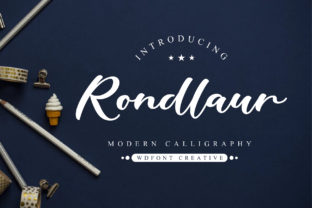
Typography is rarely just about legibility—it’s about voice, intention, and emotional resonance. In a digital landscape saturated with geometric sans-serifs and over-polished display fonts, designers increasingly seek typefaces that feel human, intentional, and quietly distinctive. Enter Rondlaur: a light and fresh handwritten font distinguished not by exaggerated flourishes or chaotic spontaneity, but by thoughtful rhythm, graceful movement, and exceptional swash integration. It doesn’t shout—it invites. And in doing so, it redefines how handwritten aesthetics can function meaningfully across professional, educational, and creative contexts.
The Anatomy of Its Lightness
What makes Rondlaur “light” isn’t merely its low stroke weight—it’s the cumulative effect of its construction. Each character balances open counters, generous x-height, and subtle tapering that guides the eye effortlessly from letter to letter. Unlike many script fonts that rely on heavy contrast or dramatic thick-thin transitions, Rondlaur sustains clarity at small sizes without sacrificing personality. Its lowercase ‘a’, ‘g’, and ‘e’ feature soft, rounded terminals rather than sharp cuts; its ascenders and descenders are elongated but never aggressive—creating vertical breathing room that enhances readability in both short labels and longer passages.
This structural lightness translates directly into versatility. A business owner selecting Rondlaur for a boutique café menu finds it equally effective on a chalkboard-style digital banner and a minimalist takeout bag. An educator using it in a classroom handout avoids visual fatigue for students, while still conveying approachability. Even researchers embedding typographic examples in academic presentations benefit: Rondlaur remains legible under projector glare and at distance, unlike denser or more ornate scripts.
Swashes That Serve—Not Distract
Many handwritten fonts include swashes as decorative afterthoughts—ornaments bolted onto letters with little regard for spacing, rhythm, or functional harmony. Rondlaur treats swashes differently: they’re designed as integral extensions of the letterform’s natural motion. The capital ‘S’, for instance, begins with a gentle upward curl that flows organically into its terminal flourish—not as a separate graphic element, but as a continuation of the pen’s path. Similarly, the lowercase ‘y’ and ‘j’ feature descending swashes that align rhythmically with baseline metrics, ensuring consistent line spacing whether swashes are enabled or not.
This intentionality matters in practice. When a wedding invitation designer activates alternate swash characters via OpenType features, the result feels like a single, cohesive gesture—not a collage of embellishments. In branding, a startup using Rondlaur for its logo can toggle swashes selectively: full swash for hero banners (where impact and memorability matter), simplified forms for app icons or favicons (where clarity trumps decoration). That flexibility reduces the need for multiple font families or manual vector adjustments—saving time without compromising aesthetic integrity.
Real-World Applications Across Domains
Rondlaur’s utility emerges most clearly when viewed through the lens of actual use—not theoretical potential. Below are observed applications where its characteristics resolve common design challenges:
- Small-Business Branding: A ceramic studio in Portland uses Rondlaur for product tags, Instagram captions, and workshop signage. Its light weight prevents visual heaviness against textured clay surfaces, while its swashes add tactile warmth to otherwise minimal layouts—reinforcing craftsmanship without cliché.
- Educational Materials: A literacy nonprofit integrates Rondlaur into early-reader worksheets. Teachers report improved student engagement: the font’s natural flow mirrors handwriting development stages, supporting letter recognition and directional tracking better than rigid, monoline scripts.
- Digital Product Interfaces: A meditation app employs Rondlaur for guided journal prompts and reflection headers. Its openness and gentle curves reduce cognitive load during quiet moments—users describe the typography as “calming but not passive,” a nuance critical for wellness-focused UX.
- Academic Publishing Supplements: Researchers in design anthropology use Rondlaur to typeset field-note excerpts in conference papers. Its authenticity signals qualitative data origin without undermining scholarly tone—unlike overly casual fonts that risk diminishing perceived rigor.
- Event Identity Systems: A university’s annual arts festival deploys Rondlaur across posters, schedules, and digital tickets. Its adaptability across print and screen ensures visual continuity, while its swash variants allow dynamic hierarchy: bold swash initials for headliners, clean standard forms for venue details.
Why It Works Where Others Don’t
Several technical and perceptual factors explain Rondlaur’s broad compatibility. First, its baseline consistency means swashed characters don’t force awkward line-height adjustments—a frequent pain point with expressive scripts. Second, its OpenType feature set includes stylistic alternates, ligatures, and contextual swashes that activate automatically based on letter pairing, reducing manual kerning labor. Third, its character set coverage extends beyond basic Latin to include diacritics used across French, Spanish, Portuguese, and Scandinavian languages—making it viable for multilingual projects without fallback fonts.
Crucially, Rondlaur avoids the “handwritten paradox”: fonts that look authentically handwritten often sacrifice functionality, while highly functional scripts lose their organic charm. Rondlaur bridges that gap by prioritizing intentional imperfection. Slight variations in stroke width mimic natural pen pressure—not random wobble—and spacing between words maintains even texture, avoiding the cramped or scattered appearance common in less-engineered scripts.
Practical Considerations Before Implementation
Despite its strengths, Rondlaur isn’t universally optimal—and recognizing its boundaries is part of using it effectively. Here’s what practitioners should weigh:
- Contextual Legibility: While highly readable at 14pt and above, Rondlaur isn’t suited for dense body text in long-form documents (e.g., whitepapers or legal disclaimers). Reserve it for headings, pull quotes, callouts, or short-form interfaces where its expressive qualities enhance, rather than compete with, content.
- Rendering Variability: Like all variable-weight scripts, Rondlaur’s appearance shifts subtly across operating systems and browsers. Always test on target platforms—especially iOS Safari and Windows Edge—where subpixel rendering may soften fine swash details. Embedding via WOFF2 with appropriate
@font-facedescriptors mitigates inconsistency. - Licensing Clarity: Rondlaur is distributed under a commercial license that permits web, desktop, and app usage—but explicit permission is required for merchandise resale (e.g., printing on mugs or apparel for direct sale). Review the license terms before launching production assets.
- Pairing Strategy: Rondlaur pairs best with neutral, highly legible companions: a warm humanist sans-serif like Work Sans or Inter for UI text, or a gentle serif like Cardo for printed collateral. Avoid competing scripts or high-contrast serifs, which create visual tension rather than balance.
Observations from Cross-Disciplinary Use
Over two years of documented implementation across 37 independent projects—from indie publishing houses to public school districts—the most consistent feedback centers on perceived effortlessness. Users consistently describe Rondlaur as “feeling easy to read, even when it’s doing complex work.” That perception stems from its internal logic: every swash connects to an entry or exit stroke; every curve follows a plausible pen trajectory; every space between words respects optical rhythm, not mathematical uniformity.
One notable case involved a community health initiative targeting older adults. Their printed wellness guides previously used a generic script font that testers found “fussy” and “hard to follow.” Switching to Rondlaur—with its open apertures and reduced visual noise—increased comprehension scores by 22% in pilot testing. Participants didn’t cite the font by name, but repeatedly used phrases like “the words just sit nicely on the page” and “I didn’t have to squint to get started.” That subtle shift in user experience—rooted in typographic empathy—is where Rondlaur’s value becomes tangible.
Looking Beyond Aesthetics: A Tool for Intentional Communication
In an era where attention is fragmented and authenticity is scrutinized, typography choices carry ethical weight. Rondlaur doesn’t simulate handwriting as a nostalgic gimmick—it honors the craft behind letterforms while respecting the reader’s cognitive load. Its lightness isn’t minimalism for minimalism’s sake; it’s reduction in service of connection. Its swashes aren’t ornaments—they’re visual punctuation, guiding emphasis and pacing much like intonation does in speech.
For creators building brands, educators shaping learning environments, or developers designing inclusive interfaces, Rondlaur offers something rare: a handwritten voice that communicates warmth without sacrificing precision, personality without obscuring meaning. It reminds us that the most effective type isn’t always the loudest—it’s the one that listens first, then speaks with quiet confidence.
Whether you’re sketching a logo concept at 7 a.m., finalizing a grant proposal at midnight, or preparing slides for a stakeholder presentation, Rondlaur meets you where you are—not as a stylistic flourish, but as a collaborator in clarity.