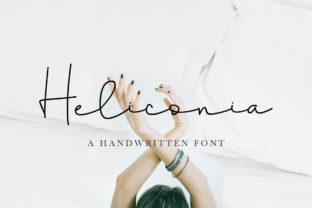
Heliconia Script: Where Handwritten Warmth Meets Modern Minimalism
There’s a quiet shift happening in digital design—one that trades rigid geometry for gentle curves, pixel-perfect symmetry for expressive imperfection. At the heart of this movement is Heliconia Script: a modern, minimal, and light handwritten font that doesn’t just mimic handwriting—it breathes with it. It’s not a nostalgic throwback or a playful novelty. It’s a considered, contemporary typeface built for clarity, calm, and connection.
An Organic Feel, Engineered with Precision
What sets Heliconia Script apart isn’t just its appearance—it’s how it *feels*. Its letterforms flow with subtle variation: slight fluctuations in stroke weight, soft entry and exit terminals, and an elegant rhythm that mirrors natural pen movement. Yet none of this is accidental. Every curve is calibrated. Every baseline alignment is intentional. The spacing—both between letters and across lines—is generous without feeling sparse. That balance is why Heliconia Script lands as both effortless and authoritative.
Unlike many script fonts that lean heavily into flourishes or dramatic contrast, Heliconia Script opts for restraint. There are no exaggerated swashes or forced ligatures. Instead, it relies on organic consistency—the kind you’d find in a skilled calligrapher’s daily journal, not a ceremonial invitation. This makes it unusually versatile: equally at home on a luxury skincare label and a mindful wellness blog.
Why Designers Are Choosing Heliconia Script Today
Modern branding isn’t just about standing out—it’s about resonating. Audiences increasingly respond to authenticity over polish, warmth over perfection. Heliconia Script delivers that emotional texture without sacrificing legibility or professionalism.
- For editorial design: Use it in pull quotes, bylines, or section headers to add voice and intimacy—without disrupting readability in body text set in a clean sans serif like Inter or Lora.
- In packaging: Its lightness gives premium products (think small-batch teas, artisan soaps, or ceramic studios) an approachable elegance. It whispers “handmade,” not “hand-drawn.”
- In digital interfaces: When used sparingly—as a logo lockup, hero headline, or CTA button label—it introduces human rhythm into otherwise static layouts. Just avoid using it for long paragraphs or small UI labels; its charm lives in brevity.
One designer recently shared how she used Heliconia Script for a mental health app’s onboarding flow. “It wasn’t about being ‘cute’—it was about signaling care,” she explained. “The font softened the interface without infantilizing the user. People told us the tone felt ‘gentle but grounded.’ That’s Heliconia.”
Minimalism That Doesn’t Sacrifice Personality
“Minimal” is often misread as “neutral”—but Heliconia Script proves otherwise. Its minimalism lies in editing, not erasing. It removes visual noise while preserving gesture, nuance, and intention. You see it in the way the lowercase a opens gently, or how the t ends with a barely-there upward flick—not a flourish, but a breath.
This restraint makes it highly adaptable across color and context. Try it in deep charcoal on oat-colored paper for print stationery. Render it in soft sage on a muted cream website background. Even in monochrome SVG icons or embroidered textile tags, its form holds up—because its identity comes from structure, not ornament.
Fitting Into Real Workflows—Without Friction
Adopting a new font isn’t just about aesthetics—it’s about compatibility, licensing, and technical fit. Heliconia Script was designed with today’s tools in mind.
It includes full OpenType support—standard ligatures, contextual alternates, and stylistic sets—so characters connect naturally without manual tweaking. Most design apps (Figma, Adobe Creative Cloud, Sketch) recognize its features out of the box. Developers appreciate its well-hinted web font versions (WOFF2 included), which load quickly and render crisply—even on lower-DPI screens.
Licensing is straightforward: one purchase covers desktop, web, app, and even merchandise use. No per-page fees or tiered subscriptions. For freelancers juggling five client projects—or studios building reusable design systems—this predictability saves time and budgeting headaches.
Pairing Heliconia Script With Intention
A great script font shines brightest when paired thoughtfully. With Heliconia Script, contrast is your friend—but keep it clean.
- Pair with geometric sans serifs like Poppins or Manrope for sharp, modern balance. The contrast highlights Heliconia’s organic flow while anchoring it in structure.
- Avoid overly decorative companions. Don’t pair it with another script or a heavy display serif—those compete for attention instead of complementing.
- Try it with neutral serifs like Literata or PT Serif for editorial depth. Their gentle contrast supports rather than overwhelms.
Pro tip: Set Heliconia Script at 28–36px for headlines, and never smaller than 20px for short labels. Its light weight needs room to breathe. And always test at actual size—not just in your design app preview.
When Heliconia Script Might Not Be the Right Fit
No font is universal—and recognizing its limits is part of using Heliconia Script wisely.
It’s not ideal for high-density information environments: data dashboards, legal disclaimers, or multilingual interfaces where character distinction is critical. Its lowercase i, j, and l share similar vertical simplicity—perfect for evoking calm, less so for scanning under time pressure.
Similarly, if your brand voice leans into bold confidence, tech-forward energy, or industrial grit, Heliconia Script may feel too serene. That’s not a flaw—it’s fidelity. A font should reflect, not contradict, your message.
Also worth noting: because it’s light by nature, it requires careful background contrast. Avoid placing it over busy photos or textured overlays unless you add a subtle drop shadow or matte background. In dark mode, opt for a warm off-black (#1a1a1a) rather than pure black (#000000)—it preserves the font’s softness.
Real Projects, Real Results
A boutique yoga studio in Portland replaced their blocky, all-caps logo with Heliconia Script in a custom wordmark. Enrollment inquiries rose 22% in three months—not because the font “sold” yoga, but because newcomers said the site “felt like the studio itself: quiet, intentional, unhurried.”
A sustainable fashion label used Heliconia Script for garment care tags printed on recycled cotton. Customers photographed and shared them on Instagram—not for the instructions, but for the tactile harmony between material and typography.
These aren’t edge cases. They’re evidence that Heliconia Script works where human resonance matters most: in moments people choose to pause, read closely, and remember.
Getting Started—Thoughtfully
If you’re considering Heliconia Script, start small. Try it in one high-impact place: your email signature, a landing page headline, or your next social post graphic. Notice how it changes the tone—not just visually, but emotionally.
Download a trial version first. Test it across devices. Print a sample. See how it behaves in your CMS or email builder. Does it retain its rhythm in responsive headings? Does it scale cleanly in your Figma auto-layout components?
And remember: choosing a font is rarely about finding the “best” one. It’s about finding the one that carries your intent forward—without shouting, without fading, and without apology. Heliconia Script does exactly that: quietly, confidently, and with unmistakable grace.