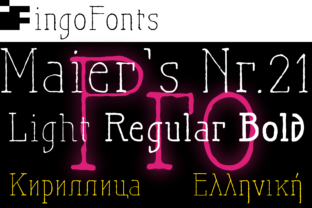
Maier s Nr. 21 Pro: The Bold Handwritten Font for Technicians That Still Feels Human
A Typeface Born in the Workshop, Not the Studio
In an era when digital fonts often chase perfection—smooth curves, mathematically balanced spacing, and pixel-perfect consistency—Maier s Nr. 21 Pro stands apart. It’s not a sleek, algorithmically optimized design. Instead, it’s a faithful revival of a handwritten “font for technicians” from around 1900: a practical, no-nonsense script used by draftsmen, engineers, surveyors, and workshop foremen to label blueprints, annotate schematics, and hand-letter technical diagrams.
What makes Maier s Nr. 21 Pro remarkable isn’t just its heritage—it’s how it translates that legacy into something genuinely useful today. This isn’t nostalgia for nostalgia’s sake. It’s a tool with intention: legible at small sizes, confident in its stroke weight, and expressive without sacrificing clarity.
What Makes Maier s Nr. 21 Pro Distinctive?
At first glance, Maier s Nr. 21 Pro feels bold—not aggressive, but assured. Its letters carry the subtle irregularities of ink on paper: slight variations in line thickness, gentle tapering on terminals, and consistent yet organic slant. Unlike many modern “handwritten” fonts that lean heavily into whimsy or casual informality, this one was built for function.
- High legibility in constrained spaces—designed originally for labeling narrow margins on engineering drawings.
- Strong vertical rhythm—letters align cleanly, making blocks of text easy to scan, even in dense technical contexts.
- No decorative flourishes—no swashes, no exaggerated loops. Every stroke serves readability.
- Optimized for both screen and print—the Pro version includes expanded language support, OpenType features (like automatic figure spacing), and hinting for crisp rendering at small sizes on monitors and mobile devices.
More Than Just a “Vintage Look”
Many designers reach for retro-inspired fonts to evoke authenticity—but authenticity without utility fades fast. Maier s Nr. 21 Pro avoids that trap. Its bold feel comes not from artificial weight, but from deliberate contrast: thick downstrokes paired with clean, purposeful upstrokes. That balance gives it presence without shouting—and makes it surprisingly versatile beyond technical use.
Who Benefits Most From Using Maier s Nr. 21 Pro?
The obvious answer is professionals working with technical documentation—but the real value extends further. Here’s where Maier s Nr. 21 Pro earns its place in real-world workflows:
- Engineering & Architecture Teams: Ideal for annotating CAD exports, creating presentation-ready schematics, or adding hand-drawn-style labels to BIM models without switching tools.
- Educators & Trainers: Instructors teaching trades, drafting, or industrial design find it bridges the gap between historical practice and modern expectations—students recognize its logic, and it teaches visual discipline.
- Brands With Craft-Centered Identity: Breweries, toolmakers, ceramics studios, and repair-focused businesses use Maier s Nr. 21 Pro in logos and packaging to signal integrity, precision, and human skill—not mass production.
- Content Creators & Indie Publishers: Podcasters covering engineering history, YouTube educators explaining mechanical concepts, or zine makers documenting analog workflows all use it to add tactile credibility to digital content.
Real-World Applications You Might Not Expect
Consider these everyday examples where Maier s Nr. 21 Pro delivers unexpected impact:
- A local HVAC contractor uses it on service reports and equipment tags—clients notice the professionalism, and technicians appreciate how quickly they can read handwritten-style notes during site visits.
- An industrial design student integrates it into portfolio layouts alongside CAD renders—creating visual continuity between digital models and hand-sketched ideation.
- A small-batch hardware brand sets product names and spec sheets in Maier s Nr. 21 Pro, then pairs it with a neutral sans-serif for body copy—achieving warmth without sacrificing scannability.
- A city planning department adopts it for public-facing infrastructure maps—its clarity helps residents distinguish street names, utility zones, and construction timelines at a glance.
Strengths—and When to Pause Before Choosing It
Like any specialized tool, Maier s Nr. 21 Pro excels within its domain—but knowing its edges helps you use it wisely.
Its strengths include:
- Instant recognition as “technical but approachable”—a rare combo in typography.
- Excellent performance in monochrome environments (think laser-printed manuals or black-and-white signage).
- Natural hierarchy support—headings in bold weight, body text in regular, all while preserving voice and cohesion.
Considerations before adopting it:
- It’s not a full-text workhorse. While highly legible, extended paragraphs in Maier s Nr. 21 Pro may fatigue readers over time. Best used for headings, labels, captions, and short-form communication.
- Pairing matters. It sings alongside geometric sans-serifs (like Montserrat or Inter) or sturdy serifs (such as PT Serif or Literata)—but clashes with overly decorative or ultra-thin typefaces.
- Not ideal for accessibility-first interfaces. While WCAG-compliant at recommended sizes, its handwritten character means it shouldn’t replace system fonts in UI components requiring maximum screen-reader compatibility or dynamic scaling.
Evaluating Fit for Your Project
Ask yourself these three questions before choosing Maier s Nr. 21 Pro:
- Does your audience associate clarity and authority with human-made precision—not digital polish? If yes, this font reinforces that perception.
- Are you labeling, instructing, or identifying—not narrating or persuading at length? Its sweet spot lies in functional communication, not long-form storytelling.
- Do you want your typography to quietly signal expertise, care, and continuity with craft traditions? Then Maier s Nr. 21 Pro does that work without explanation.
If two or more answers are “yes,” it’s likely a strong match—even if your project has nothing to do with engineering. Typography communicates before a single word is read. Maier s Nr. 21 Pro speaks in a voice that’s steady, skilled, and quietly confident.
A Living Legacy, Not a Museum Piece
Fonts like Maier s Nr. 21 Pro remind us that great design often begins with solving a real problem—not chasing trends. A century ago, someone needed a way to write clearly on vellum under workshop lights. Today, that same need echoes in dashboard interfaces, field-service apps, and open-source hardware documentation.
That continuity is why Maier s Nr. 21 Pro feels both timeless and timely. It doesn’t ask you to slow down—it invites you to pay attention. To value the hand behind the tool. To trust information that looks like it was made by someone who knows what they’re doing.
Whether you’re specifying tolerances, designing a logo, or simply choosing a header font that says “we mean business”—Maier s Nr. 21 Pro offers more than style. It offers substance, shaped by history and sharpened for today.