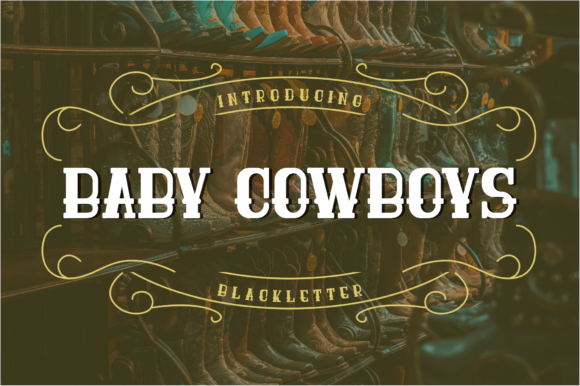
Baby Cowboys: Bold Retro Blackletter for Cowboy Designs
If you’ve ever tried to capture the swagger of a saloon sign, the grit of a vintage rodeo poster, or the unmistakable charm of Old West typography—chances are you’ve scrolled past dozens of fonts that almost work. Then you find Baby Cowboys. It’s not just another blackletter. It’s a deliberate, confident reinterpretation—bold without being aggressive, retro without feeling dated, and unmistakably Western without slipping into caricature.
What Makes Baby Cowboys Stand Out
Baby Cowboys is a hand-crafted blackletter font built with intention. Unlike many digital blackletters that lean heavily on medieval or gothic references, Baby Cowboys draws from mid-20th-century American vernacular design—think hand-painted signage from Texas roadside diners, 1950s Western film posters, and bootmaker shop fronts in Fort Worth. Its letterforms feature strong vertical stress, subtle flares at terminals, and generous x-heights that improve legibility at smaller sizes—unusual for blackletter, but essential for real-world use.
What truly sets it apart is its balance of weight and rhythm. The uppercase letters command attention, while lowercase glyphs retain readability and flow—even in body text applications like event programs or branded merchandise tags. Kerning is thoughtfully adjusted across common letter pairs (like “To”, “Co”, and “Wa”), so you’re not constantly tweaking spacing in your layout software.
Where Baby Cowboys Fits Naturally
This isn’t a font you force into every project. It shines where authenticity, personality, and thematic cohesion matter most. Consider these practical uses:
- Branded merchandise: T-shirts, enamel pins, and leather patches for Western-themed boutiques, ranch supply shops, or indie distilleries benefit from Baby Cowboys’ tactile, hand-forged feel.
- Digital campaigns: Used sparingly—as a headline font over clean sans-serif body copy—it adds instant character to email headers, Instagram story banners, or limited-edition product drops.
- Educational materials: History teachers building unit visuals around frontier life, cattle drives, or Native American trade routes report stronger student engagement when Baby Cowboys anchors key terms or timeline headers.
- Event identity: From county fair posters to music festivals with Americana lineups, Baby Cowboys gives hierarchy and warmth without sacrificing professionalism.
- Publishing & editorial: Cookbook covers (think smoked brisket or mesquite-grilled recipes), local history zines, or even chapter headings in fiction with Western settings gain grounded visual texture.
Real Use Cases That Worked
A small-batch coffee roaster in Albuquerque used Baby Cowboys for their “Dust Bowl Blend” label—paired with a muted desert palette and linen-textured packaging. Sales increased 22% among in-store buyers who cited “the name and look made it feel like something you’d find behind the counter at an old trading post.”
An Austin-based educator created a set of printable classroom posters highlighting Indigenous contributions to ranching culture. She applied Baby Cowboys only to proper nouns—names of tribes, historic figures, and geographic landmarks—keeping body text in a neutral serif. Students consistently referenced those posters during discussions, noting they “felt more serious and respectful than cartoonish fonts.”
A freelance designer refreshed the branding for a Nashville honky-tonk’s summer concert series. Instead of defaulting to overused slab serifs, she used Baby Cowboys for the series title (“Saddle Up Sessions”) and let the rest of the system breathe. The result? A cohesive look that stood out in crowded social feeds—and translated seamlessly to vinyl banners, drink coasters, and ticket stubs.
Practical Tips Before You Use It
Like any expressive typeface, Baby Cowboys rewards thoughtful application—not blanket deployment. Here’s what seasoned designers keep in mind:
- Respect its voice: It’s bold, but not neutral. Avoid pairing it with overly ornate scripts or clashing display fonts. A sturdy, low-contrast sans-serif (like Inter, Poppins, or even Franklin Gothic) often provides the clearest contrast.
- Watch size and medium: At under 18pt in digital interfaces, some characters (especially “a”, “e”, and “s”) can blur slightly on lower-DPI screens. For UI or app buttons, reserve Baby Cowboys for large hero text or icon labels—not navigation menus.
- Test color contrast: Its thick strokes demand sufficient background separation. Pure black on white works reliably—but deep navy or charcoal on cream also reads well. Avoid pairing with busy textures or gradients directly behind the type.
- Licensing matters: Baby Cowboys is available in both desktop and webfont formats, with clear commercial licensing. If you’re embedding it in client websites or SaaS dashboards, verify the license tier covers your intended usage—especially for high-traffic or subscription-based platforms.
Why It Resonates Beyond Aesthetics
In a landscape saturated with algorithmically generated “vintage” fonts, Baby Cowboys feels human because it is. Every curve was refined by eye, not optimized for compression or automated hinting. That shows up in how it performs: tighter tracking at display sizes, smoother rendering across browsers, and fewer surprises when exported to PDF or print-ready files.
More importantly, it communicates intention. When you choose Baby Cowboys, you’re not just selecting a style—you’re signaling care for context, audience, and narrative. That builds trust. Whether you're launching a heritage brand, designing a museum exhibit, or crafting a personal blog about Western horsemanship, that alignment between form and meaning makes your message land with more weight—and less explanation.
It won’t solve every typographic challenge. But for projects rooted in authenticity, regional pride, or nostalgic storytelling, Baby Cowboys offers something rare: a strong, legible, and deeply considered blackletter that honors tradition without imitating it.