Sallita: A Light, Beautiful Signature Font with a Bold Twist
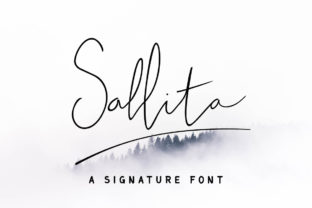
Sallita is a signature-style display font designed to balance elegance and presence. It’s not a script that mimics handwriting in a literal sense—instead, it’s carefully crafted to feel personal, fluid, and intentional. Its light baseline gives it airiness and readability at larger sizes, while its bold twist—most notably in the weighted terminals, deliberate swashes, and confident letter connections—adds visual authority without sacrificing grace. This duality makes Sallita especially useful where authenticity matters: brand logotypes, editorial headers, invitation suites, and product packaging that aims to stand out through character rather than volume.
What Sets Sallita Apart From Other Signature Fonts
Many signature fonts fall into one of two categories: those that prioritize delicate, almost fragile thinness—or those that lean heavily into dramatic contrast, thick-to-thin transitions, and ornate flourishes. Sallita occupies a thoughtful middle ground. Its stroke weight remains relatively consistent across characters, avoiding the fragility of ultra-light scripts that vanish at smaller sizes or on low-resolution screens. At the same time, it avoids the visual density of high-contrast fonts that can overwhelm supporting text or compete with imagery.
The “bold twist” isn’t applied uniformly—it appears selectively. For example, the capital S and T feature subtle but unmistakable thickening at their base and apex, grounding the word visually. The lowercase g and y include gentle, open loops—not tightly coiled or overly decorative—so they retain clarity even when set at 36pt or smaller. These decisions reflect an understanding of real-world use: legibility across print and digital contexts, scalability in responsive layouts, and compatibility with both minimalist and layered design systems.
How Sallita Fits Into Broader Typography Categories
Signature fonts like Sallita belong to the broader category of display typefaces—but unlike geometric sans-serifs or classic serifs, they serve a distinct communicative role. They’re rarely used for body text. Instead, they function as voice: a way to signal tone, intention, and personality before a single word is read. Within that category, Sallita leans toward modern calligraphy rather than traditional copperplate or Spencerian styles. It lacks sharp angles, rigid spacing rules, or strict baseline alignment—making it more approachable and adaptable for contemporary branding.
Compared to handwritten-style fonts generated from digitized pen strokes, Sallita benefits from optical refinement. Every curve has been adjusted for consistency in rhythm and spacing; kerning pairs were tuned manually, not algorithmically. That means words like “Sallita” or “Celebrate” flow naturally without awkward gaps or collisions—a practical advantage when typesetting short, high-impact phrases.
Strengths in Practice: Where Sallita Performs Best
Sallita shines in contexts where visual identity hinges on nuance. Consider a boutique skincare line launching a new line of botanical serums. Using Sallita for the product name—paired with a neutral, highly legible sans-serif for ingredient lists and usage instructions—creates immediate differentiation. The font conveys care and craftsmanship without veering into clichéd “handmade” tropes. Similarly, a wedding stationery designer might choose Sallita for names and dates, knowing it balances romance and restraint better than overly florid alternatives.
Its light structure also supports color flexibility. Unlike heavier scripts that dominate color palettes, Sallita works well in soft pastels, deep jewel tones, or even monochrome treatments. It doesn’t require heavy outlines or drop shadows to hold its own—reducing production complexity in both print and web environments.
Tradeoffs and Situations Where Sallita May Not Be the Right Fit
Sallita is intentionally designed for impact—not endurance. It’s not suitable for long-form reading, UI labels, navigation menus, or data-dense interfaces. Its connected letters and flowing forms reduce scanability in paragraph settings, and its lack of extensive language support (e.g., extended Latin diacritics, Cyrillic, or Greek) limits multilingual applications unless supplemented with a compatible secondary font.
Another consideration is context sensitivity. In highly technical, institutional, or corporate environments—think financial reports, legal disclaimers, or enterprise software dashboards—Sallita’s expressive nature may misalign with audience expectations. Here, clarity, neutrality, and familiarity outweigh stylistic distinction. Likewise, if a project requires tight vertical rhythm (such as magazine mastheads stacked above compact headlines), Sallita’s generous x-height and open counters may demand more line spacing than tighter alternatives allow.
Comparing Use Cases: When to Choose Sallita Over Other Options
Suppose you’re evaluating fonts for a new artisanal coffee roaster’s rebrand. You’re weighing Sallita against a clean serif (like Playfair Display) and a warm, rounded sans-serif (like Quicksand). Each serves different strategic goals:
- Sallita emphasizes origin story, craft, and human touch—ideal if the brand narrative centers on small-batch roasting, direct trade relationships, or hand-poured tasting notes.
- Playfair Display conveys tradition, heritage, and editorial authority—better suited if the focus is on coffee history, regional terroir, or written storytelling.
- Quicksand signals accessibility, friendliness, and approachability—more fitting for a café chain aiming to lower barriers to entry or highlight community events.
The choice isn’t about which font is “better,” but which best supports the message without requiring explanation. Sallita earns its place when the goal is to evoke sincerity and distinction—not just style, but stance.
Technical and Practical Considerations
Sallita is typically offered in a single weight with accompanying ligatures and alternate characters. That simplicity is a strength for focused applications, but it also means limited typographic hierarchy within the family itself. Designers often pair it with a robust companion font—ideally one with clear contrast in structure (e.g., a sturdy geometric sans) and complementary proportions (similar x-height, balanced ascender/descender length).
Licensing is another practical factor. Sallita is commonly available through reputable foundries and font marketplaces, with options for desktop, web, and app licensing. Always verify the license scope before committing—especially for client work involving embedded digital products or large-scale print runs. Some versions include OpenType features like contextual alternates and discretionary ligatures; these enhance typographic polish but aren’t essential for basic use.
Making an Informed Choice
Choosing a signature font involves more than aesthetics—it’s about alignment between form and function. Sallita offers a rare combination: lightness that breathes, beauty that feels earned, and a bold twist that adds quiet confidence. It works best when the design goal is to invite attention without demanding it, to express individuality without overshadowing content, and to suggest authenticity without relying on artifice.
If your project values subtlety over spectacle, craft over convention, and resonance over repetition, Sallita deserves serious consideration. But if your needs center on versatility across languages, scalability in interface elements, or typographic flexibility within a single family, other options—whether modular scripts, variable sans-serifs, or hybrid display faces—may provide more sustainable utility.
Ultimately, the right font emerges not from trend or preference alone, but from how well it serves the people who’ll encounter it—and how consistently it helps communicate what matters most.