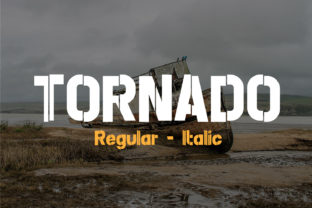
Tornado: A Rusty, Bold Decorative Font That Commands Attention—Strategically
When a typeface doesn’t just sit on the page but seems to lean forward—rough-edged, unapologetic, and charged with presence—you’re likely looking at Tornado. It’s not a workhorse font for body text or a neutral sans-serif built for legibility at scale. Tornado is a decorative font with a distinct personality: rusty texture, bold weight, irregular contours, and a sense of controlled chaos. Its utility isn’t in universality—it’s in intentionality. Used well, Tornado becomes a strategic signal—not decoration for decoration’s sake, but visual punctuation with purpose.
Why Tornado Works Where Other Fonts Don’t
Most brands and creators default to safe fonts because they’re familiar, scalable, and predictable. But familiarity rarely builds distinction—and predictability rarely sparks memory. Tornado counters that by offering something rare in digital typography: textural authenticity. The “rusty” quality isn’t simulated grit; it’s baked into the letterforms—slight asymmetries, uneven stroke endings, subtle erosion cues that suggest time, use, and character. That makes it unusually effective when you need to communicate resilience, raw creativity, grounded energy, or artisanal confidence.
Consider how a small-batch coffee roaster might position itself—not as “premium,” but as unrefined, honest, rooted. Pairing clean, functional body text with Tornado for the shop name or tagline creates an immediate tonal contrast: clarity meets character. The font doesn’t explain the brand—it embodies part of it. That kind of alignment reduces cognitive load for the viewer: they don’t have to interpret the message twice.
Where Tornado Delivers Real Strategic Value
Tornado excels in high-impact, low-frequency contexts—places where you control attention, not sustain it. Think: logos, event posters, book covers, podcast thumbnails, hero section headlines, limited-run packaging, or signature campaign slogans. In each case, the goal isn’t readability over time—it’s resonance in the first 2–3 seconds.
- Branding moments: When launching a new product line that signals a pivot toward boldness or craft, Tornado can anchor the visual identity before a single word is read.
- Editorial emphasis: A magazine feature on industrial design or urban renewal might use Tornado for pull quotes—its texture echoes the subject matter without needing illustration.
- Physical touchpoints: Letterpress business cards, screen-printed tote bags, or stamped metal signage gain dimension when Tornado’s roughness translates literally into material texture.
What matters isn’t whether Tornado looks “cool”—it’s whether its qualities align with what your audience needs to feel or believe at that precise moment. That requires asking: What outcome do I want this piece to drive? If the answer is “recognition,” “memorability,” or “tonal alignment,” Tornado may be the right tool. If the answer is “clarity,” “scanability,” or “accessibility at small sizes,” it’s not.
How to Use Tornado Without Undermining Your Goals
Using Tornado effectively starts with restraint—not rules. There’s no universal “do not use” list, but there are high-risk patterns worth avoiding:
- Body text: Its decorative density sacrifices legibility below ~24px. Even at larger sizes, extended reading fatigues the eye. Reserve it for short bursts—never paragraphs.
- Low-resolution screens: Thin details and rust textures blur or disappear on older devices or compressed web assets. Always test on actual mobile hardware—not just browser emulators.
- Overused contrast pairings: Slapping Tornado over a chaotic background image or pairing it with another highly textured font dilutes its impact. Let it breathe—white space, solid color blocks, or minimalist layouts amplify its presence.
A practical planning tip: sketch your layout in grayscale first. If the hierarchy holds without color or imagery—if Tornado still reads as the focal point—then the typographic decision is structurally sound. If it vanishes or competes, simplify before adding polish.
Decision-Making Guidance for Real Projects
Before licensing or implementing Tornado, run through three quiet questions:
- Is this the only place where this tone needs to land? If your website already uses strong visual metaphors (e.g., hand-drawn icons, monochrome photography), Tornado may reinforce—or overwhelm—those cues. Audit existing assets first.
- Who sees this first—and what do they need to know immediately? A festival poster seen from across a street benefits from Tornado’s bold silhouette. A legal disclaimer at the bottom of a checkout page does not.
- Can this choice scale without eroding meaning? If you plan to use Tornado across five product variants, ensure each application feels deliberate—not repetitive. One variant could use it for the name only; another might apply it to a short descriptor (“Hand-Forged,” “Batch #42”) to preserve freshness.
This isn’t about limiting creativity—it’s about directing it. Tornado gains power from scarcity. Overuse flattens its uniqueness into cliché.
Risks of Using Tornado Without Context
The biggest risk isn’t aesthetic failure—it’s misalignment. A financial advisory firm using Tornado for its homepage headline may unintentionally signal volatility instead of stability. A children’s educational app deploying it for interface labels may confuse usability with personality. These aren’t “bad designs”—they’re decisions made without anchoring the font to a clear outcome.
Another subtle risk: accessibility oversights. While Tornado itself isn’t inherently inaccessible, its irregular shapes can challenge users relying on screen readers if improperly implemented (e.g., using CSS text-transform: uppercase on non-semantic elements). Always pair it with proper heading structure (h1, h2) and avoid replacing semantic HTML with visual styling alone.
Finally, consider longevity. Decorative fonts age faster than neutral ones. Tornado feels current today because it balances trend-aware texture with timeless structural boldness—but revisit its use every 18–24 months. Does it still reflect who you are—or has it become nostalgic shorthand for a phase you’ve moved beyond?
Long-Term Positioning: When Tornado Becomes Part of Your Visual Vocabulary
For creators building recognizable, values-driven work—freelancers refining their portfolio voice, educators designing course materials with distinctive energy, small businesses cultivating local loyalty—Tornado can evolve from a one-off accent into a consistent, meaningful cue. Not as a logo lockup used everywhere, but as a recurring motif tied to specific ideas: “This is where we take risks,” “This is our unfiltered perspective,” “This is handmade, not outsourced.”
That kind of consistency requires documentation—not rigid rules, but light guidelines. For example: “Tornado appears only in headlines of published essays about creative process,” or “Used exclusively for physical workshop signage, never digitally.” These constraints don’t limit expression—they sharpen it.
And remember: typography is never neutral. Every font carries associations shaped by decades of cultural use. Tornado’s rust implies endurance, not decay; its boldness suggests conviction, not aggression. Leverage those connotations deliberately—and always ask whether the feeling it evokes matches the action you want the viewer to take next.
Final Thought: Choose Tornado Like You’d Choose a Signature Tool
You wouldn’t use a chisel for every carpentry task—only where precision, grain exposure, or tactile character matters. Tornado functions the same way. It’s not about whether it’s “better” than other fonts. It’s about whether, in this specific context, with this specific audience and outcome in mind, it helps you say what needs saying—more clearly, more memorably, or more authentically than anything else available.
That kind of decision-making doesn’t come from trend reports or font previews. It comes from knowing your goals deeply enough to recognize when a rusty, bold decorative font like Tornado isn’t just appropriate—it’s necessary.