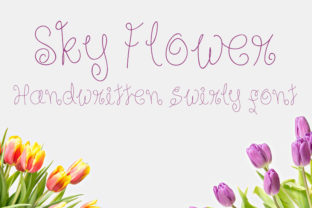
Sky Flower: A Strategic Choice for Meaningful Visual Communication
Handwritten fonts carry weight—not just aesthetic weight, but psychological and strategic weight. When chosen with intention, they signal authenticity, care, and human presence. Sky Flower is not merely decorative; it’s a swirly, floral-inspired handwritten font that balances elegance with approachability. Its delicate curves, organic spacing, and botanical rhythm make it distinct from generic script fonts. But its value isn’t in how it looks alone—it’s in how it functions within your broader communication strategy.
Why Sky Flower Fits Purpose-Driven Design Decisions
Most designers reach for script fonts to evoke warmth or creativity—but many default to options that lack nuance or cultural resonance. Sky Flower stands apart because its floral motif isn’t literal or cutesy; it’s subtle, refined, and mature. That matters when you’re communicating with adults aged 20–50 who respond to sincerity over sentimentality. A wellness coach using Sky Flower for a workshop title doesn’t signal “cute”—they signal intentional calm. A small-batch candle brand applying it to a limited-edition label doesn’t shout “handmade”—it quietly affirms craft and continuity.
This distinction supports real-world goals: building trust without overpromising, differentiating in saturated markets, and reinforcing brand voice across touchpoints. Unlike fonts that rely on trendiness, Sky Flower gains strength through consistency—not repetition. Used once per campaign, it can anchor memory. Used across three years of seasonal packaging, it becomes part of your visual grammar.
When Sky Flower Adds Strategic Value—And When It Doesn’t
Sky Flower works best where legibility isn’t the sole priority—and where emotional resonance carries measurable weight. Consider these high-leverage use cases:
- Branded invitations and event collateral: Weddings, retreats, gallery openings, or intimate product launches benefit from its quiet confidence—not flash, but presence.
- Editorial accents in long-form content: A pull quote in Sky Flower within an otherwise clean serif layout creates breathing room and emphasis without disrupting flow.
- Signature elements in service-based branding: Therapists, educators, and consultants often rely on tone to convey empathy. A logo lockup or letterhead detail in Sky Flower subtly reinforces that commitment to human-centered practice.
- Limited-run print assets: Think workshop workbooks, artisanal recipe cards, or hand-signed thank-you notes—contexts where scarcity and attention to detail matter more than scalability.
Conversely, avoid Sky Flower where clarity, speed, or neutrality are non-negotiable: legal disclaimers, data dashboards, multilingual interfaces, or fast-scrolling social feeds. Its beauty lies in slowness—not in immediacy. Using it in those contexts doesn’t add charm; it adds friction. That’s not a flaw in the font—it’s a mismatch in strategic alignment.
How to Use Sky Flower Without Undermining Your Message
Intentional use starts before opening your design app. Ask yourself:
- What outcome do I want this element to support? Is it recognition? Emotional connection? Perceived craftsmanship? If the answer is vague (“it just looks nice”), pause. Revisit your objective.
- Who will encounter this—and what do they need from it right now? A busy educator scanning a conference handout needs hierarchy and scannability first. A client browsing your portfolio website may linger longer—making Sky Flower’s texture more effective.
- Does this usage reinforce—or dilute—my existing voice? If your brand voice is direct and grounded, a single flourish in Sky Flower can humanize without contradicting. But layering it across headlines, buttons, and captions risks inconsistency.
Practically, pair Sky Flower with strong typographic contrast. Set body text in a highly legible sans-serif like Inter or a warm serif like Lora. Let Sky Flower breathe—don’t crowd it with competing scripts or excessive ornamentation. One well-placed instance often outperforms five scattered ones.
Risks of Using Sky Flower Without Context
The biggest risk isn’t poor rendering or licensing confusion—it’s misalignment. When Sky Flower appears without clear rationale, it can unintentionally communicate indecision, nostalgia without purpose, or even amateurism. That’s especially true for professionals whose credibility rests on precision: financial advisors, HR leaders, technical trainers. In those fields, visual choices must serve authority—not soften it.
Another underdiscussed risk is accessibility fatigue. While Sky Flower passes basic contrast checks at larger sizes, its swirly forms reduce character distinctness at smaller scales or on low-resolution screens. If your audience includes older adults or those with mild visual processing differences, test rigorously—not just for compliance, but for cognitive load.
Finally, consider longevity. Fonts gain meaning through repeated, thoughtful application—not novelty. Launching a new brand identity with Sky Flower as the primary headline font may feel fresh today, but ask: Will it still feel intentional two years from now? Will it scale across evolving platforms—from email headers to AR experiences? If the answer hinges on current trends rather than enduring qualities, reconsider.
Planning for Long-Term Value With Sky Flower
Treat Sky Flower like a tool with specific operating parameters—not a universal solution. Build it into your design system with documented guidelines:
- Usage tiers: Define “primary” (e.g., logo lockups), “secondary” (e.g., section dividers), and “restricted” (e.g., never in UI components).
- Size thresholds: Specify minimum point sizes for print and screen to preserve legibility and intent.
- Color constraints: Note which palettes enhance its floral softness versus those that mute or distort its character.
- Substitution logic: Identify fallback fonts for environments where Sky Flower can’t render—without sacrificing tone.
This kind of planning turns aesthetic preference into operational discipline. It also makes collaboration smoother: a freelancer updating your newsletter knows exactly when—and when not—to reach for Sky Flower. That consistency compounds over time, turning visual choices into quiet signals of reliability.
Realistic Expectations for Sky Flower’s Impact
No font transforms strategy on its own. Sky Flower won’t fix unclear messaging, compensate for weak positioning, or mask inconsistent customer experience. What it can do is amplify what’s already working—adding grace to clarity, warmth to expertise, and humanity to systems.
Think of it like lighting in architecture: subtle, directional, and often unnoticed—until it’s missing. A well-placed beam highlights texture, defines space, and guides attention. So does Sky Flower, when used with similar restraint and purpose.
For entrepreneurs launching a mindful skincare line, it might be the difference between “another natural brand” and “one that feels known before it’s named.” For educators designing a professional development guide, it could transform a dry syllabus into something that invites engagement—not just compliance. These aren’t magical outcomes. They’re the result of aligning form with function, aesthetics with audience, and beauty with intention.
That’s why Sky Flower remains valuable—not because it’s trending, but because it invites deeper thinking about how we show up visually in a world saturated with noise. The most effective uses aren’t the loudest. They’re the ones that feel inevitable, once you see them.