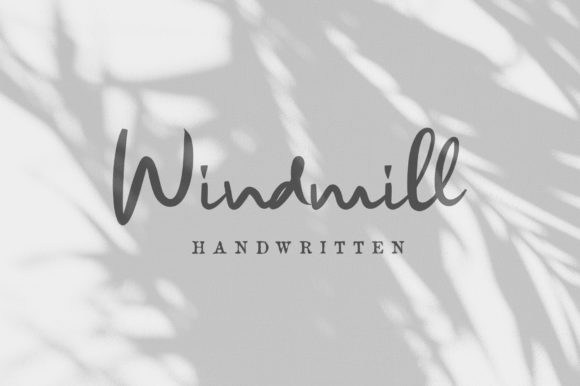
Windmill: A Light, Minimalist Font with Authentic Character
Windmill stands out not by shouting, but by speaking clearly—quietly, confidently, and with intention. It’s a contemporary sans-serif typeface designed for legibility and warmth without sacrificing structure or neutrality. Unlike many minimalist fonts that lean into clinical austerity or over-refined geometry, Windmill retains subtle humanist cues: gently tapered terminals, soft contrast in stroke weight, and open apertures that support readability at small sizes and on screen. Its authenticity isn’t performative—it emerges from thoughtful construction, not stylistic affectation.
What Makes Windmill Distinctive in Practice
At its core, Windmill is built for utility—not novelty. Its light weight (available in Regular and Medium, with optional Italic) gives it exceptional versatility in interface design, editorial layouts, and branding systems where visual breathing room matters. The letterforms avoid extreme uniformity: the lowercase a and g are single-story but retain natural rhythm; the e has a slightly tilted crossbar; the t features a modest upward flick at the stem. These aren’t quirks—they’re refinements that prevent monotony in extended text while preserving typographic harmony.
Spacing and kerning have been carefully tuned for both digital and print environments. In web use, Windmill renders cleanly across browsers and operating systems, including older versions of Safari and Android WebView. Its x-height sits comfortably between traditional text faces and modern UI fonts—neither too dominant nor too recessive—making it effective for body copy, captions, navigation labels, and even short headlines when paired thoughtfully.
Where Windmill Excels—and Where It Doesn’t Try To
Windmill performs best where clarity, calm, and quiet confidence are priorities. Consider a nonprofit’s annual report: dense data, personal narratives, and donor-facing messaging benefit from Windmill’s even color and unobtrusive presence. A boutique studio’s website—featuring hand-drawn illustrations and muted photography—finds cohesion with Windmill’s restrained voice. Educators building course materials appreciate how its open counters and generous spacing reduce cognitive load for learners scanning PDFs or reading on tablets.
It’s less suited for high-impact display contexts requiring dramatic contrast or expressive flair—think movie posters, luxury fashion campaigns, or experimental art publications. Windmill doesn’t offer bold or black weights, nor does it include variable-axis interpolation. That’s intentional: it’s a focused tool, not an all-in-one solution. Users expecting extensive stylistic range may find its family limited—but those valuing consistency, speed of implementation, and typographic integrity often cite this restraint as a strength.
Real-World Usability Across Platforms
Windmill ships in standard OpenType (.otf) and web-optimized WOFF2 formats. Its file size remains modest—under 40 KB for the full set—so it loads quickly without compromising rendering quality. When self-hosted, it avoids third-party font service dependencies, which matters for privacy-conscious publishers or teams managing strict content security policies.
In Figma, Sketch, and Adobe Creative Cloud, Windmill integrates smoothly. Its metrics align predictably with other well-engineered sans-serifs, reducing layout shifts during design-to-development handoff. Developers appreciate that it includes basic Latin, extended Latin-1, and common diacritics—covering English, Spanish, French, German, Portuguese, Dutch, and Scandinavian languages without fallback concerns in most regional deployments.
- Web typography: Works reliably with
font-display: swap, ensuring fast perceived loading without invisible text. - Print production: Prints crisply at 300+ DPI, with no hinting artifacts or glyph misalignment.
- Accessibility: Meets WCAG 2.1 AA contrast thresholds at 16px and above when used with appropriate background colors.
Audience Fit: Who Benefits Most From Windmill
Freelancers building brand identities for local service businesses—plumbers, therapists, yoga studios—often choose Windmill because it conveys professionalism without coldness. Its lightness reads as approachable; its structure signals competence. Small business owners updating their Shopify storefront or Notion knowledge base find it easy to implement without custom CSS or developer support.
Bloggers and independent publishers using Ghost or Substack rely on Windmill for its clean hierarchy: headings remain distinct without overpowering, and body text flows without fatigue—even in long-form essays or technical documentation. Marketers crafting email newsletters notice improved scan rates when replacing default system fonts with Windmill, especially in mobile previews where tight line spacing and narrow widths can hinder readability.
Educators preparing slide decks or handouts value its legibility at distance and under varied lighting conditions. Unlike ultra-thin fonts that vanish on projectors or matte screens, Windmill’s Regular weight maintains presence without heaviness. One university communications team reported fewer requests for “larger font” adjustments after switching from Lato to Windmill in internal training materials.
Practical Integration Tips
For optimal results, pair Windmill with a neutral serif (e.g., Literata, PT Serif, or even Georgia for system fallbacks) when contrast between heading and body text is needed. Avoid pairing it with highly geometric sans-serifs like Futura or Montserrat—the differences in rhythm and proportion can feel jarring rather than complementary.
In responsive design, start with font-size: 1rem and line-height: 1.6 for body text on desktop, scaling down to 15px and 1.55 on mobile. Its light weight benefits from slightly increased line height to preserve airiness. For accessibility, ensure foreground/background contrast exceeds 4.5:1—especially important with the Regular weight on light gray or off-white backgrounds.
If using Windmill in logos or wordmarks, test at multiple sizes and output formats. Its lightness works well in vector applications but may require minor stroke adjustment for small-scale embroidery or laser engraving where fine detail is lost.
Long-Term Value and Design Longevity
Windmill isn’t chasing trends. It avoids decorative ligatures, discretionary alternates, or stylistic sets that complicate usage or dilute focus. That makes it resilient: a font chosen today remains appropriate five years from now, whether deployed in a static brochure or a dynamic React component. Its lack of trend-driven features also means fewer updates to manage—no version conflicts, no breaking changes across releases.
From a licensing standpoint, Windmill typically offers perpetual desktop and web licenses with clear attribution requirements (if any). This stability supports budget predictability for agencies and solopreneurs alike. There’s no subscription model or usage-based pricing—just straightforward access aligned with how professionals actually work.
That said, Windmill isn’t universally ideal. Teams needing multilingual support beyond Western European languages will need to plan for fallbacks or supplemental fonts. Designers working heavily in motion graphics may find its light weights less impactful in video titles unless backed by subtle stroke effects or shadow layers. And while its personality is authentic, it’s not idiosyncratic—those seeking strong typographic voice may prefer something more distinctive.
In practice, Windmill earns its place not through flash, but through reliability. It’s the kind of font you stop thinking about once it’s in place—because it simply works. When your goal is communication that feels human, unhurried, and trustworthy—not loud, not clever, not complicated—Windmill delivers with quiet consistency.