Pestapora: A Handwritten Font with Cheerful Personality and Practical Versatility
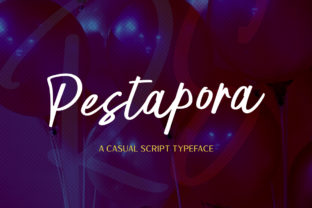
Pestapora is a distinctive handwritten font designed to convey warmth, energy, and approachability. Unlike many script fonts that lean heavily into formal elegance or casual looseness, Pestapora occupies a balanced middle ground—structured enough for clarity, expressive enough for character. Its letters feature consistent baseline rhythm, subtle variation in stroke weight, and playful yet legible connections between characters. This combination makes Pestapora especially effective when personality matters but readability can’t be compromised.
What Sets Pestapora Apart from Other Handwritten Fonts
Not all handwritten fonts serve the same purpose—or even the same audience. Some prioritize authenticity at the cost of consistency; others optimize for speed of reading but lose charm. Pestapora stands out by maintaining strong visual cohesion across its character set while preserving organic movement. Its lowercase “a,” “g,” and “y” include thoughtful alternate forms, offering designers flexibility without requiring deep typographic expertise.
Unlike fonts generated from quick pen scans or traced vector sketches, Pestapora was crafted deliberately—each glyph refined for spacing, balance, and contextual harmony. That attention shows in real-world use: headlines retain impact at small sizes, and short body text (like event invitations or social media graphics) remains inviting rather than exhausting to read.
Fitting Pestapora Into Your Design Workflow
Pestapora works best where tone and identity are central—branding for creative studios, packaging for artisanal goods, signage for cafés or boutiques, and digital assets like email headers or Instagram story templates. Its cheerful vibe supports positivity-driven messaging without veering into childishness, thanks to restrained flourishes and grounded proportions.
It’s less suited for long-form editorial text, legal disclaimers, or interfaces requiring rapid scanning—contexts where high x-height sans-serifs or neutral serifs typically perform better. Pestapora also doesn’t include extensive language support beyond basic Latin characters, so multilingual projects may need supplemental typefaces.
Comparing Pestapora With Common Alternatives
When evaluating handwritten fonts, designers often weigh three practical dimensions: expressiveness, legibility, and adaptability. Pestapora scores highly on expressiveness and mid-to-high on legibility—but its adaptability depends on context.
- Compared to ultra-casual brush scripts: Fonts with heavy texture or irregular baselines can feel energetic but risk inconsistency across platforms. Pestapora delivers similar warmth with tighter control over kerning and line height—making it more predictable in responsive layouts.
- Compared to formal calligraphic fonts: These often emphasize tradition and refinement, which suits luxury or heritage brands. Pestapora avoids that formality, making it more appropriate for modern, inclusive, or youth-oriented initiatives.
- Compared to minimalist handwritten options: Some fonts strip away almost all variation to maximize neutrality. Pestapora retains enough nuance to feel human without demanding extra design effort to manage visual noise.
This isn’t about declaring one font “better.” It’s about alignment: does the voice you’re building match what Pestapora offers? If your goal is to signal friendliness, creativity, and sincerity—not authority, austerity, or nostalgia—Pestapora often fits more naturally than alternatives that default to one extreme or another.
Real-World Use Cases Where Pestapora Adds Value
A local bakery redesigned its seasonal menu board using Pestapora for item names and short descriptors. Customers reported the layout felt “more personal” and “easier to scan,” even though no other changes were made to hierarchy or color. The font’s open counters and moderate contrast helped maintain clarity under uneven lighting—something denser scripts struggled with.
Another example: a nonprofit launching a community storytelling campaign used Pestapora for quote highlights in digital newsletters. Test feedback showed higher engagement with those sections versus previous versions set in a generic script font—readers described the typography as “inviting” and “warm,” not “distracting” or “hard to follow.”
These aren’t edge cases. They reflect how Pestapora’s balance supports communication goals where emotional resonance and functional clarity intersect.
Technical Considerations and Integration Notes
Pestapora is delivered as a standard OpenType font file (.otf), compatible with Adobe Creative Cloud apps, Figma, Sketch, and most modern design tools. It includes standard ligatures and stylistic alternates accessible via OpenType features—no plugins or special software required.
Web use requires proper licensing and hosting. Self-hosting via @font-face works reliably, but ensure fallbacks are defined (e.g., “cursive” or a clean sans-serif) for graceful degradation. Avoid pairing Pestapora with other decorative fonts—it shines when given breathing room alongside neutral companions like Inter, Lato, or Source Sans Pro.
One practical note: Pestapora performs best at medium to large sizes (24px and up for web, 18pt+ for print). At very small scales, some letter connections may blur slightly, so always test in final output conditions—not just in design previews.
When Pestapora May Not Be the Right Choice
There are clear scenarios where stepping back from Pestapora makes sense. If your project emphasizes precision, gravitas, or universal accessibility, a more neutral typeface will likely serve users better. For instance, government health advisories, technical documentation, or financial disclosures benefit from typographic transparency—not added personality.
Likewise, if your brand voice leans toward bold minimalism, industrial rawness, or futuristic sleekness, Pestapora’s warmth may unintentionally soften messaging. In those cases, a geometric sans-serif or monospaced option might reinforce intent more effectively.
Also consider production constraints. While Pestapora simplifies design decisions for small teams, larger organizations with strict brand guidelines may find its expressive nature harder to standardize across departments or external vendors—especially if those partners lack typographic training.
Making an Informed Decision
Choosing a font like Pestapora isn’t just about aesthetics—it’s about selecting a tool that supports your message, audience, and execution reality. Ask yourself:
- Does the tone I want to communicate align with Pestapora’s cheerful, grounded energy—or would something more restrained or more exuberant serve better?
- Where will this type appear? Will it be seen on mobile screens, printed posters, or embedded in video? Does Pestapora hold up in those contexts?
- Who is interpreting this design? Are readers likely to value approachability—or do they expect authority, efficiency, or neutrality first?
- What resources do I have for implementation? Can I test variations easily, or do I need something that works predictably out of the box?
There’s no universal “best” font—only the best fit for a specific intention, environment, and audience. Pestapora excels when those conditions involve human-centered communication, visual warmth, and moderate complexity. It won’t solve every typographic challenge, but where it fits, it adds quiet confidence and genuine charm.
Final Thoughts on Using Pestapora Thoughtfully
Fonts shape perception before a single word is read. Pestapora invites attention without demanding it, expresses personality without overwhelming meaning, and supports creativity without sacrificing usability. That balance is rare—and worth recognizing.
If you’ve been comparing handwritten options and found many feel either too rigid or too unruly, Pestapora offers a pragmatic third path. It’s not a shortcut—it still benefits from thoughtful hierarchy, spacing, and contrast—but it reduces the guesswork in conveying sincerity and energy. Used with awareness of its strengths and boundaries, Pestapora becomes more than decoration. It becomes part of the message itself.