Allanis: A Handwritten Font with Lightness and Authenticity
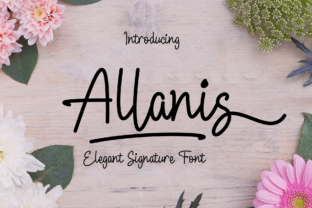
Allanis is a classic, original handwritten font designed to evoke natural movement and quiet confidence. Unlike many script fonts that lean heavily into flourish or formality, Allanis carries a light, airy feel—achieved through delicate stroke contrast, open letterforms, and subtle irregularities that mirror genuine pen-on-paper motion. It’s not overly decorative, nor is it minimalist to the point of sterility. Instead, Allanis occupies a thoughtful middle ground: expressive enough for personality-driven design, restrained enough for clarity and versatility.
What Sets Allanis Apart
At its core, Allanis distinguishes itself through intentionality in weight and rhythm. Its baseline sways gently—not dramatically, but just enough to suggest human handcraft. Letters connect fluidly where appropriate, yet retain breathing room; spacing feels considered rather than automated. The lowercase a, g, and y feature soft, rounded terminals instead of sharp flicks or abrupt stops—contributing to its approachable tone. Capital letters are understated, avoiding dominance over body text, making Allanis work well in mixed-case settings like headlines paired with clean sans serifs.
This lightness isn’t just aesthetic—it’s functional. In digital contexts where screen legibility matters, Allanis avoids the visual density that can fatigue readers in longer passages. It doesn’t try to mimic calligraphy tools (e.g., broad nibs or pointed pens), so it sidesteps the rigid expectations those associations bring. That makes it adaptable across mediums: from product packaging labels to wedding stationery, editorial pull quotes to app onboarding screens.
How Allanis Fits Within the Handwritten Font Landscape
Handwritten fonts fall along a spectrum—from tightly controlled, almost typewriter-like scripts to wildly energetic, brush-based expressions. Allanis sits comfortably in the “refined casual” zone. It’s less structured than fonts designed for formal invitations (think precise copperplate derivatives), and less exuberant than high-energy brush scripts used for festival posters or beverage branding.
Compared to other light-handed options, Allanis avoids two common pitfalls: excessive thinness (which risks pixelation at small sizes) and over-smoothing (which erases character). Some alternatives prioritize uniformity for technical consistency—resulting in fonts that feel digitally generated, even when labeled “handwritten.” Allanis retains variation in stroke width and angle without sacrificing coherence. That balance supports authenticity without compromising usability.
Strengths in Practice
Allanis excels where warmth and readability must coexist. For example, a wellness brand launching a new line of herbal teas might use Allanis for flavor names on packaging (“Lavender Calm,” “Citrus Dawn”)—its softness reinforcing calm and natural ingredients, while remaining legible at shelf distance. Similarly, an independent bookstore could apply Allanis to event banners or newsletter headers, pairing it with a neutral sans serif for body copy. The contrast feels intentional, not jarring.
In UI design, Allanis works well for microcopy that benefits from gentle emphasis—like empty-state messages (“Nothing here yet—start adding your favorites!”) or celebratory notifications (“You’ve reached 100 days!”). Its light weight prevents visual shouting, supporting user calm rather than urgency.
Tradeoffs and Considerations
No handwritten font is universally suitable—and Allanis is no exception. Its lightness becomes a limitation in environments demanding high contrast or long-form readability. It’s not ideal for body text in print magazines or dense web articles. At very small sizes (below 14px on screen or under 8pt in print), some details—like the subtle entry and exit strokes—may blur or disappear entirely. Users should test rendering across devices and platforms, especially if deploying in responsive interfaces.
Also worth noting: Allanis does not include extensive language support out of the box. While it covers standard Latin characters and common diacritics (à, ñ, ü), users working with extended European, Central Asian, or non-Latin scripts will need to verify coverage or plan fallbacks. This isn’t a flaw unique to Allanis—it reflects common constraints in niche display fonts—but it’s a practical factor in multilingual projects.
When Allanis Is Likely the Right Choice
- You’re designing for audiences that value sincerity over polish—think artisanal goods, personal coaching services, or boutique education platforms.
- Your project balances visual identity with functional clarity—such as a mobile app interface where tone matters but usability is non-negotiable.
- You need a font that pairs naturally with both geometric sans serifs (like Inter or Poppins) and warmer humanist options (like Lora or Source Serif).
- You’re prioritizing emotional resonance in short-form applications: logos, social media graphics, email subject lines, or product tags.
When You Might Explore Alternatives
- If your project requires extended reading—like a blog, documentation site, or academic publication—consider a dedicated text face first, then layer in Allanis selectively for headings or accents.
- For high-contrast signage or outdoor advertising, a bolder, more robust script—or even a custom-drawn solution—may deliver better impact and durability.
- If your brand voice leans toward bold playfulness (e.g., children’s toys, streetwear, or music festivals), Allanis’ restraint may feel too subdued next to more dynamic options.
- When multilingual support is essential from day one and the project timeline doesn’t allow for custom extensions or testing fallback behavior, broader-coverage fonts may reduce risk.
Pairing and Implementation Tips
Allanis thrives in contrast. Its lightness gains definition when set beside sturdy, unadorned typefaces. Try pairing it with a neutral sans serif at 1.5×–2× its size for hierarchy, or with a low-contrast serif for editorial depth. Avoid pairing with other scripts unless they’re markedly different in weight and rhythm—two light handwritten fonts competing for attention tend to dilute each other’s effect.
In CSS, use font-weight: 400 as intended—Allanis wasn’t built for faux-bold rendering. If bold variants are needed, choose a complementary bold sans rather than forcing weight via browser interpolation. Kerning adjustments may improve spacing in all-caps usage, though Allanis was primarily designed for sentence-case application.
Making an Informed Choice
Selecting a font like Allanis isn’t about finding the “best” option—it’s about matching expressive intent with practical constraints. It’s worth asking: What feeling do you want viewers to carry away? How much space does the text occupy relative to other elements? Will it be seen on a phone screen, a printed brochure, or a large-format poster? Answers to those questions often clarify whether Allanis aligns with your goals—or whether another option better serves the context.
Testing matters more than theory. Try setting real content—not placeholder text—in your actual layout. View it at multiple sizes, on different devices, and in ambient lighting. Notice where clarity holds and where it falters. That kind of grounded evaluation reveals more than any stylistic description ever could.
Allanis won’t solve every typographic challenge. But for designers and communicators seeking a handwritten voice that feels both genuine and composed—light without being fragile, personal without being idiosyncratic—it offers a distinctive and reliable presence.