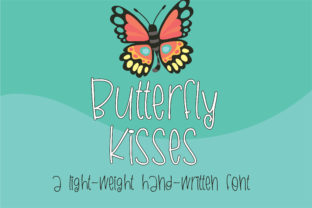
Butterfly Kisses: A Handwritten Font with Adorable Charm
Butterfly Kisses isn’t just another script font—it’s a quiet spark of personality in a sea of polished, predictable type. With its relaxed, slightly uneven baseline, gentle curves, and soft contrast between thick and thin strokes, it feels handwritten by someone who’s confident, kind, and unhurried. It doesn’t shout. It leans in. That’s why designers, educators, small business owners, and creators across disciplines keep returning to it—not for every project, but for the right ones.
What Makes Butterfly Kisses Stand Out
Unlike many casual scripts that veer into overly decorative or hard-to-read territory, Butterfly Kisses balances charm with clarity. Its lowercase letters flow naturally, while uppercase forms retain distinction without stiffness. The spacing is open enough for legibility at medium sizes (16–24px), and its subtle irregularities—like a slightly lifted ‘e’ or a tapered ‘y’ tail—add warmth without sacrificing cohesion.
This isn’t a font designed for dense paragraphs or technical documentation. It shines where tone matters as much as text: invitations, social media graphics, product labels, classroom posters, blog headers, and handmade packaging. Its “adorable feel” comes from authenticity—not perfection—but it’s grounded enough to avoid looking childish or fleeting.
Creative Uses Across Real Projects
Think beyond “cute.” Consider how Butterfly Kisses supports intent and audience:
- Small business branding: A local bakery uses Butterfly Kisses for its chalkboard-style menu board and custom tote bags—pairing it with a clean sans-serif (like Inter or Lato) for body text. The contrast feels intentional, not chaotic.
- Educational materials: A kindergarten teacher creates themed reading logs and reward certificates with Butterfly Kisses for headings and student names. Kids recognize the friendly rhythm; parents appreciate the approachability.
- Digital content: A wellness blogger applies Butterfly Kisses to Instagram quote cards (“Breathe in kindness”) and newsletter headers. She limits it to one line per graphic and avoids all-caps to preserve readability on mobile screens.
- Printed stationery: An indie wedding planner includes Butterfly Kisses in digital save-the-dates and printed thank-you notes—always testing print output first, since ink spread can soften fine details on uncoated paper.
How to Use It Thoughtfully (Not Just Decoratively)
Great typography serves the message—not the other way around. With Butterfly Kisses, restraint is part of the strategy:
- Limit hierarchy roles: Use it only for primary headlines, short quotes, or signature elements—not subheads, captions, or body copy. Let supporting fonts handle the work of information delivery.
- Pair intentionally: Match its warmth with neutral, highly legible sans-serifs (e.g., Open Sans, Poppins, or Montserrat). Avoid pairing with other scripts or overly ornate serifs—they compete instead of complement.
- Test at real size: On screen, render it at 20px and 32px. In print, check how it holds up at 14pt on letterhead or 48pt on a banner. Adjust tracking slightly (+10–+20) if letters feel cramped in longer words like “beautiful” or “together.”
- Respect context: It works beautifully for a handmade soap label but feels out of place on a law firm’s annual report. Ask: *Does this use reflect who the audience is—and what they need to feel, not just see?*
Adapting Butterfly Kisses for Different Audiences
One font, many interpretations—depending on how you frame it:
- For entrepreneurs: Use Butterfly Kisses to humanize a service-based brand—think coaching, therapy, or creative workshops. It signals empathy and accessibility without sounding unprofessional.
- For educators: Apply it selectively in visual learning tools—vocabulary cards, emotion charts, or classroom rules posters—to support emotional literacy and engagement, especially with younger learners.
- For marketers: Leverage its friendly tone in email subject lines, limited-time offer banners, or user onboarding screens—where warmth builds trust faster than formality.
- For hobbyists and makers: Stamp or hand-letter over Butterfly Kisses outlines for greeting cards, embroidery patterns, or ceramic decals. Its forgiving shape invites reinterpretation—not replication.
Maintaining Clarity and Consistency
Because Butterfly Kisses has expressive character, consistency keeps it effective—not repetitive. Define simple usage rules early:
- Only one weight (regular) across all touchpoints.
- Never stretch or skew the font—its charm lives in natural proportions.
- Use the same color palette (e.g., muted terracotta + warm gray) wherever it appears.
- Keep line length under 40 characters when used solo (e.g., “You’ve got this” or “Hand-poured • Small batch”).
These aren’t restrictions—they’re guardrails that help your audience recognize your voice instantly, even without a logo.
Where Butterfly Kisses Fits in Your Creative Toolkit
It’s not a solution for every challenge. But when you need to signal care, calm, creativity, or connection—without saying a word—Butterfly Kisses delivers quietly and confidently. It’s the font you reach for when “friendly but focused,” “gentle but grounded,” or “playful but purposeful” is the goal.
Try this: Open your design tool. Type three short phrases—“Thank you,” “Just for you,” “Made with love”—in Butterfly Kisses. Then step back. Notice where your eye lingers. That’s where its strength lies—not in volume, but in resonance.
Use it where attention is earned through sincerity, not scale. Pair it where contrast adds meaning, not noise. And above all—let it support your message, not overshadow it. That’s how Butterfly Kisses becomes more than a font. It becomes part of your voice.