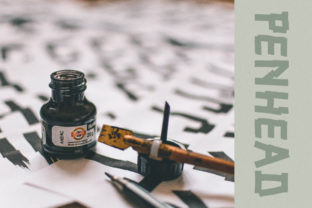
Penhead: A Thoughtful Script Font for Distinctive Visual Communication
Penhead stands out not because it shouts, but because it speaks with intention. It’s an original script font designed with a hand-drawn sensibility—fluid yet controlled, expressive but legible. Unlike many decorative scripts that sacrifice function for flair, Penhead balances character with clarity. Its strokes carry the warmth of ink on paper: subtle tapering, gentle contrast, and organic rhythm that avoids mechanical repetition. That makes it more than just another display typeface—it’s a tool for designers and communicators who want authenticity without compromising professionalism.
What Sets Penhead Apart From Other Script Fonts
Most script fonts fall into one of two categories: highly formal calligraphic styles suited for luxury branding, or casual, brush-based fonts better suited for social media graphics. Penhead occupies a deliberate middle ground. Its letterforms feature consistent x-heights, open counters, and generous spacing—traits that support readability at moderate sizes. The lowercase a, e, and s retain distinct shapes even in tighter settings, reducing ambiguity. Uppercase letters have presence without dominance, making them effective for short headlines or monogram treatments.
The design avoids overused flourishes. There are no excessive swashes by default—though optional stylistic alternates are included—so Penhead adapts cleanly to both minimalist layouts and layered compositions. Its baseline alignment is stable, and kerning pairs have been carefully adjusted across common combinations (e.g., “To”, “The”, “Love”), which reduces manual tweaking during implementation.
Practical Use Cases and Real-World Performance
In practice, Penhead excels where personality matters but precision can’t be compromised. A small-batch coffee roaster used it for their seasonal label series—pairing it with a neutral sans-serif for body text—and reported improved shelf recognition without alienating older customers accustomed to traditional typography. Similarly, an independent educator redesigned her course workbook covers with Penhead for titles and chapter headers; students noted the materials felt “more human” and less institutional, while still maintaining academic credibility.
It performs well in digital contexts too—particularly in hero sections, email headers, and branded slide decks—provided sizing and contrast meet accessibility standards. At 24px and above on light backgrounds, readability remains strong. On mobile, it holds up best in larger display roles (e.g., app onboarding screens or banner text) rather than body copy. As with any script, line length and spacing need attention: tight tracking can blur word boundaries, so testing at intended size and context is essential.
Quality and Technical Considerations
Penhead ships in OpenType format with full Latin character support (including diacritics for Western European languages), standard ligatures, and discretionary alternates. It includes true small caps, tabular figures, and proportional old-style numerals—features often missing in niche script fonts. These aren’t just cosmetic extras; they allow consistent typographic hierarchy across mixed-content projects like newsletters or multi-page reports.
File size is modest (~180 KB for the full family), and webfont versions load efficiently when subsetted. Variable font support isn’t built in, but static weights (Regular and Bold) provide enough contrast for most applications without overwhelming a project’s typographic system. The Bold weight maintains stroke integrity—no pixelation or uneven thickening—making it viable for emphasis without visual dissonance.
Who Benefits Most—and When It Might Not Fit
Penhead serves creators who value tonal nuance: freelance designers building brand identities for lifestyle brands, boutique agencies crafting packaging for artisan goods, bloggers developing cohesive visual themes, or educators designing learning materials that feel approachable yet polished. It’s especially useful when the goal is differentiation within competitive niches—think wellness coaching, handmade ceramics, indie publishing, or local hospitality—where perceived authenticity influences trust and engagement.
That said, it’s not universally appropriate. Long-form editorial work, legal documentation, data dashboards, or interfaces requiring rapid scanning (e.g., SaaS onboarding flows) benefit more from highly legible, neutral typefaces. Penhead’s charm lies in its specificity—not versatility. Using it for navigation menus or dense paragraph text would undermine both usability and its own strengths.
Integration Tips for Better Results
- Pair intentionally: Combine with a sturdy, low-contrast sans-serif (e.g., Inter, Poppins, or DM Sans) rather than another decorative face. Avoid pairing with high-contrast serifs unless the project calls for deliberate tension.
- Respect hierarchy: Use Penhead for primary headings or logotypes only. Let supporting type handle information density—subheadings, captions, and body text should remain clear and functional.
- Test color contrast: Its thin strokes require sufficient contrast against backgrounds. On dark mode UIs or textured surfaces, verify legibility at actual scale—not just in mockups.
- Leverage alternates sparingly: The stylistic set includes subtle variations for g, y, and z. Use them to break repetition in multi-word headlines, but avoid mixing too many variants in one line.
Long-Term Value and Workflow Fit
Typography choices often reflect long-term brand strategy—not just one-off projects. Penhead’s consistency across weights and language support means it scales with growing needs: a startup’s first website banner can evolve into a full brand system spanning print collateral, video lower-thirds, and merch without visual whiplash. Its lack of trend-driven exaggeration also helps future-proof designs—unlike ultra-thin or hyper-distorted scripts popular in fleeting design cycles, Penhead’s grounded proportions keep it relevant across seasons.
For freelancers managing multiple clients, having a reliable script option like Penhead reduces time spent hunting for “just right” alternatives. Its predictability—how it renders across browsers, CMS editors, and design tools—minimizes revision rounds. Designers familiar with Adobe Fonts or Google Fonts ecosystems will find Penhead straightforward to license and deploy, with clear documentation and responsive vendor support.
A Final Note on Intentional Typography
Choosing Penhead isn’t about chasing aesthetic novelty. It’s about selecting a voice that aligns with how you want your message received—thoughtful, crafted, and quietly confident. It won’t solve vague branding challenges or compensate for weak content, but in the hands of someone who understands timing, tone, and audience context, it becomes a quiet amplifier. Whether you’re refining a logo lockup, designing a book cover, or updating a portfolio site, Penhead offers a level of considered detail that rewards close attention—both from the designer applying it and the viewer encountering it.