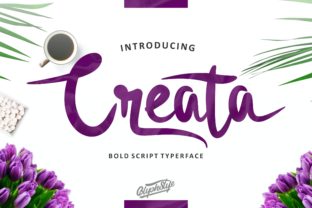
Creata: A Modern Script Font for Design Projects
Creata is a bold and smooth script font designed with a contemporary aesthetic. It combines fluid, connected letterforms with consistent stroke weight and subtle contrast—characteristics that distinguish it from both traditional calligraphy-inspired scripts and highly decorative display typefaces. Its structure supports readability at larger sizes while retaining expressive personality, making it suitable for projects where visual impact and modern elegance are priorities.
Why Consider Creata?
Designers often seek typefaces that convey tone without relying on imagery or layout alone. Creata stands out in contexts where a human touch—yet one refined by digital precision—is desired. Its balanced rhythm and open spacing contribute to legibility in headlines, logos, and short-form editorial use. Because it avoids extreme flourishes or irregular baseline shifts, Creata offers more versatility than many high-contrast or ultra-decorative scripts.
People researching fonts like Creata typically fall into two groups: those building brand identities (e.g., lifestyle brands, boutique studios, creative agencies) and those working on targeted design deliverables such as invitations, packaging, or social media assets. In both cases, the goal is often to communicate sophistication, approachability, or artistic intention—without sacrificing clarity or scalability.
Key Benefits of Using Creata
- Distinctive yet restrained presence: Unlike many script fonts that prioritize ornamentation over function, Creata maintains even spacing and predictable letter connections, reducing visual noise in composed text.
- Cross-platform compatibility: Available in standard OpenType format, Creata works reliably across design software (Adobe Creative Suite, Figma, Affinity) and web environments when properly embedded.
- Strong hierarchy support: Its bold weight pairs effectively with clean sans-serif or low-contrast serif companions, enabling clear typographic contrast in multi-font layouts.
- Modern aesthetic alignment: The font’s even curves and uniform terminals reflect current design sensibilities—particularly relevant for audiences valuing minimalism with warmth.
Tradeoffs and Practical Considerations
No script font excels universally—and Creata is no exception. Its strengths lie primarily in display settings. At small sizes (below 24px), letter connections and tight counters can reduce legibility, especially in body copy or long paragraphs. It is not intended for extended reading, nor does it include extensive language support beyond Latin-based scripts; users working with multilingual content should verify glyph coverage before committing.
Another consideration is licensing. Creata is a commercial font, meaning usage rights depend on the license purchased. Web use, app embedding, and desktop licensing may require separate permissions. Designers evaluating Creata should confirm whether their intended application falls within the scope of their license—especially in client work where redistribution or long-term hosting may be involved.
Also worth noting: Creata’s smoothness comes partly from its limited variation in stroke modulation. While this enhances consistency, it may feel less dynamic compared to high-contrast scripts like Great Vibes or Parisienne. Users seeking dramatic flair or historical authenticity may find Creata too neutral for certain expressive goals.
When Creata Is a Strong Fit
Creata performs best in controlled, intentional applications. It shines in logo design for brands centered around creativity, wellness, fashion, or artisanal goods—where tone matters as much as message. Its even weight distribution allows it to scale cleanly across formats, from business cards to large-format signage.
It also works well in editorial design for section headers, pull quotes, or cover lines—particularly in magazines, lookbooks, or digital newsletters targeting design-aware audiences. Because its rhythm supports moderate line lengths, it integrates smoothly into grid-based layouts without overwhelming surrounding elements.
For motion graphics or UI micro-interactions—such as animated loading text or hover states—Creata’s clean joins and predictable metrics make it easier to animate consistently than more irregular scripts.
When Alternatives May Be More Appropriate
If your project requires extended text blocks—even modest ones like event descriptions or product blurbs—Creata is unlikely to serve well. In those cases, pairing a legible serif or humanist sans-serif with a subtle script accent (e.g., for initials or dividers) often yields better results.
Projects needing broad language support—including Central/Eastern European diacritics, Greek, or Cyrillic—should verify Creata’s character set. Fonts like Quicksand (a rounded sans with friendly tone) or Playfair Display (a high-contrast serif with script-like elegance) may offer wider linguistic coverage without sacrificing aesthetic cohesion.
For strictly handwritten authenticity—think personal stationery, signature-style branding, or artisanal labeling—fonts with variable stroke weight, ink traps, or natural imperfections (e.g., Homemade Apple or Sorts Mill Goudy) may better match expectations. Creata’s digital polish, while an asset in many contexts, can read as “too perfect” where organic texture is essential.
Making a Practical Decision
Evaluating Creata isn’t about whether it’s “good” in absolute terms—it’s about fit. Start by clarifying your primary use case: Is it for a logo? A series of social posts? A print campaign? Then ask three questions:
- What is the minimum size at which the text will appear? If smaller than 28px regularly, test readability with real content—not just “The quick brown fox.”
- How much text will be set in Creata? Limiting use to short, high-impact phrases maximizes effectiveness and minimizes fatigue.
- Does the font align with existing brand attributes? Compare its tone against brand voice guidelines—if “friendly but professional” is core, Creata’s balance may suit well; if “rebellious” or “rustic” is central, it may feel misaligned.
Finally, always test in context. Render Creata alongside your chosen supporting typeface, on representative devices and backgrounds. Observe how it behaves in both static and interactive states. Real-world testing reveals more than theoretical analysis—especially with script fonts, where spacing, kerning, and rendering engines significantly affect outcome.
Ultimately, Creata serves designers who value intentionality over ornamentation. It rewards thoughtful application and offers reliable performance where its constraints are respected. When matched to the right project—one that values modernity, clarity, and quiet confidence—it becomes more than a type choice. It becomes part of the message.