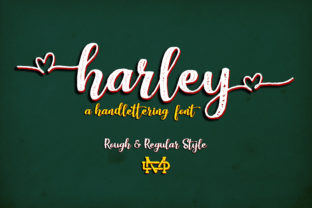
Harley Script
Harley Script isn’t just another handwritten font—it’s a warm, expressive voice on the page. With its natural flow, subtle inconsistencies, and gentle rhythm, it captures the charm of real pen-on-paper writing without feeling overly scripted or stiff. It’s not about perfection; it’s about personality. That authenticity is why designers, small business owners, educators, and creatives keep coming back to Harley Script when they want their work to feel human, approachable, and memorable.
Where Harley Script Fits Naturally—Not Just as Decoration
Think of Harley Script as the kind of font you’d choose for a message you’d write by hand on a postcard—not because it looks “cute,” but because it feels right. Its versatility shines most when context matters more than uniformity.
Small Businesses Building Trust and Warmth
A local bakery launching a seasonal menu? Harley Script gives that chalkboard-style sign a genuine, artisanal vibe—no stock illustration needed. A handmade soap brand using Harley Script on product labels or Instagram story highlights instantly signals care, craft, and connection. Customers don’t just see a logo; they sense intention. One candle maker told us she switched from a generic script to Harley Script for her packaging—and saw a 22% increase in repeat customers citing “how friendly everything felt.” That’s not coincidence. It’s tone, translated into typography.
Educators and Learning Materials That Invite Engagement
Teachers crafting classroom posters, printable worksheets, or digital lesson slides often wrestle with fonts that either feel too childish or too cold. Harley Script strikes a balance: it’s legible at size, retains warmth in digital formats, and subtly signals “this is made for *you*”—not mass-produced curriculum. A homeschooling parent shared how using Harley Script for weekly learning goals helped her kids engage more consistently. “It doesn’t shout ‘assignment’—it says ‘let’s explore together.’” That emotional resonance matters more than perfect kerning when attention is scarce.
Wedding and Event Designers Crafting Moments, Not Just Mockups
Invitations, place cards, ceremony programs—these aren’t just documents. They’re early touchpoints in an emotional experience. Harley Script adds intimacy without sacrificing elegance. Unlike ultra-thin, high-contrast scripts that can feel fragile or distant, Harley Script has just enough weight and variation to hold up beautifully in print—even on textured paper or letterpress. One designer noted how clients consistently described invitations set in Harley Script as “feeling like a personal note from the couple,” even before opening them.
Who Benefits Most—and How They Use It Differently
Harley Script isn’t one-size-fits-all—but it *is* highly adaptable. The way a freelance illustrator uses it differs meaningfully from how a nonprofit communications manager does—and both are valid.
- Illustrators & Surface Designers: Layer Harley Script over watercolor textures or hand-drawn borders to reinforce a cohesive, tactile aesthetic. Its slight irregularities pair naturally with organic shapes—no need to force alignment.
- Nonprofit Storytellers: Use it sparingly in donor thank-you letters or impact reports to soften institutional language. A headline in Harley Script next to clean body text (like Inter or Lora) creates contrast that guides emotion—not just the eye.
- Content Creators (Bloggers, Newsletter Writers): Drop Harley Script into email subject lines (when supported), Pinterest graphics, or lead magnets like printable habit trackers. It stands out in crowded inboxes—not because it’s flashy, but because it feels intentionally human.
What to Keep in Mind Before You Use It
Harley Script earns its charm through imperfection—but that means it’s not always the best tool for every job. Being thoughtful about where and how you apply it helps it land with impact instead of confusion.
Legibility Is Context-Dependent
At small sizes (under 16px on screen or under 10pt in print), some characters—especially lowercase a, g, and s—can blur together. That’s fine for a decorative banner or social media graphic where quick scanning isn’t the goal—but avoid using it for dense paragraphs, legal disclaimers, or accessibility-critical text. Pair it thoughtfully: let Harley Script open the conversation, then switch to a clear serif or sans-serif for the details.
Brand Consistency Requires Intention
Because Harley Script feels so personal, it can unintentionally shift your brand’s perceived tone if used inconsistently. If your website headers use Harley Script but your product descriptions switch to three different fonts across pages, the result feels less “handwritten charm” and more “unplanned.” Start small: pick one high-impact use case (e.g., your newsletter signature or hero section headline), test it across devices, and expand only once it feels unmistakably *yours*.
Technical Considerations Are Real—but Manageable
Harley Script includes OpenType features like ligatures and alternate characters, which add depth when supported (e.g., in Adobe Creative Cloud or modern web browsers via @font-face). But basic platforms like Canva or Mailchimp may only access the standard character set. That’s okay—many users get excellent results with just the default glyphs. If you’re embedding it on a website, serve it as a WOFF2 file and define fallbacks (e.g., font-family: "Harley Script", cursive;) to ensure graceful degradation.
When Harley Script Might Not Be the Right Fit
That doesn’t mean it’s limited—just that clarity of purpose helps you use it well. Avoid Harley Script when:
- You need strict typographic control for multi-language support (it’s optimized for English and common Western European languages, not extended Unicode sets).
- Your audience skews toward formal or technical contexts—think financial dashboards, engineering schematics, or academic journals—where neutrality and precision take priority over expressiveness.
- You’re designing for environments where readability under time pressure is essential (e.g., wayfinding signage, emergency instructions, or fast-scrolling mobile feeds).
None of those are flaws—they’re boundaries. And knowing them helps Harley Script shine brighter where it belongs: in moments meant to be felt, remembered, and shared.
Real Inspiration Starts With Real Use
You don’t need a full rebrand to try Harley Script. Print a quote you love in it and tape it to your desk. Draft your next Instagram caption using it in a design app—even if you end up switching fonts later, you’ll notice what shifts emotionally. Add it to a PDF checklist for your team and watch how the tone softens. These small experiments build intuition faster than any tutorial.
Harley Script works because it doesn’t try to be everything. It’s not a system font. It’s not built for spreadsheets or code editors. It’s built for the quiet confidence of a signature, the warmth of a handwritten note, the grounded joy of making something that feels truly yours. And in a world full of polished, predictable type, that kind of authenticity isn’t just refreshing—it’s rare.