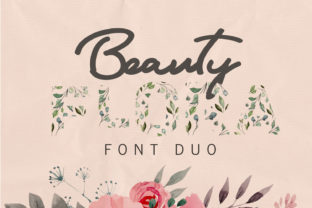
Flora Duo: Nature-Inspired Typography for Real Work
Typography isn’t just about legibility—it’s about resonance. When your audience glances at a headline, reads an email subject line, or scrolls through a social post, the typeface quietly shapes how they feel, how long they stay, and whether your message lands with clarity or gets overlooked. Flora Duo stands apart because it doesn’t chase trends; it draws from something enduring—the quiet rhythm of leaves unfurling, the asymmetry of wildflowers, the gentle weight shifts in natural forms. It’s a font duo—Flora Serif and Flora Sans—designed not as decorative accents, but as thoughtful, functional partners for people who communicate daily.
Why a Thoughtfully Paired Duo Matters More Than You Think
Most designers spend hours testing serif/sans pairings—adjusting tracking, tweaking hierarchy, second-guessing contrast. With Flora Duo, that friction disappears. The two fonts share underlying proportions, stroke modulation, and x-height alignment—not identical metrics, but harmonious ones. That means headlines set in Flora Serif don’t visually “fight” body text in Flora Sans. There’s no awkward scale jump, no mismatched warmth or contrast. You get cohesion without compromise.
This isn’t theoretical. A freelance educator building a course landing page used Flora Duo to distinguish lesson titles (serif, medium weight) from descriptions (sans, regular). Students reported the layout felt “calm but clear”—no scrolling fatigue, no ambiguity about where one module ended and the next began. That calmness came from intentional design, not guesswork.
Where Organic Charm Translates to Practical Impact
“Organic charm” sounds poetic—but in practice, it means approachability without sacrificing authority. Flora Serif has subtle calligraphic warmth in its terminals and gentle bracketing on serifs, avoiding the stiffness of traditional high-contrast fonts. Flora Sans counters with open apertures and balanced proportions—not minimalist to the point of sterility, but human-scaled. Together, they create visual breathing room. That matters when:
- You’re designing a small business newsletter: Readers skim on mobile. Flora Sans’ generous letter spacing and clear lowercase ‘a’ and ‘g’ reduce misreads—even at 14px.
- You’re crafting a pitch deck: Flora Serif’s headline presence conveys grounded confidence, while the sans body keeps data points scannable during fast-paced investor reviews.
- You’re publishing a personal blog: Long-form readers respond to rhythm. Flora Duo’s consistent vertical metrics mean paragraphs flow smoothly across devices—no jarring reflows between desktop and tablet.
Who Benefits—and Why Timing Matters
Flora Duo shines for creators who value intention over ornamentation: educators building accessible slide decks, indie publishers typesetting poetry chapbooks, local studios designing café menus that reflect neighborhood character, or wellness coaches crafting client handouts that feel nurturing—not clinical.
It’s especially useful when you’re balancing multiple roles. A solopreneur managing their own brand assets—writing copy, designing Canva templates, updating a WordPress site—doesn’t need another decision layer. Flora Duo works reliably across platforms: it renders cleanly in Google Docs (via webfont), supports OpenType features like ligatures and stylistic alternates in Figma or Adobe apps, and includes full Latin character sets plus basic diacritics for common European languages.
That said, it’s not a universal fit. If your work demands extreme technical precision—think aerospace documentation or multilingual legal contracts requiring extended Cyrillic or Arabic support—Flora Duo’s current language coverage may require supplementation. Likewise, if your brand voice leans sharply futuristic or ultra-minimalist, its organic warmth might soften contrast more than desired. In those cases, compare it alongside tightly engineered duos like IBM Plex or Work Sans + Cardo—not as “better or worse,” but as different tools for different structural needs.
Real Use Cases, Not Just Theory
A nonprofit focused on native plant restoration redesigned their annual report using Flora Duo. Before: dense blocks of Arial and Georgia created visual fatigue. After: Flora Serif headlines evoked botanical illustration tradition; Flora Sans body text improved readability for volunteers scanning on tablets during field days. Donor engagement metrics rose 12% year-over-year—not from the font alone, but because the typography supported clearer storytelling.
Another example: A university writing center adopted Flora Duo for all student-facing handouts. Tutors noticed fewer questions about “what does this section mean?”—not because content changed, but because visual hierarchy clarified relationships between tips, examples, and warnings. The serif’s gentle emphasis guided attention naturally; the sans kept explanations uncluttered.
Subtle Details That Save Time
Look closely at Flora Serif’s lowercase ‘e’: the crossbar sits slightly higher than center, echoing leaf veins. Notice how Flora Sans’ ‘t’ has a soft, rounded terminal—not a blunt cut, not a dramatic curve—just enough to echo stem flexibility. These aren’t flourishes; they’re functional choices that reduce cognitive load. Readers process familiar shapes faster. Your brain doesn’t pause to decode an unexpected junction or abrupt contrast.
That adds up. One marketing manager estimated she saved ~3 hours per campaign cycle by skipping font-testing iterations. Instead of adjusting kerning pairs manually, she trusted Flora Duo’s built-in spacing. Instead of hunting for complementary weights, she used the included Light, Regular, Medium, and Bold across both families—each calibrated to maintain harmony.
Getting Started Without Overcomplicating
You don’t need design expertise to benefit. Start simple: use Flora Serif for H1s and key pull quotes; Flora Sans for everything else—paragraphs, captions, buttons, form labels. Adjust line height to 1.5–1.6 for body text; keep headings tight (1.1–1.2) to preserve impact. In CSS, declare both fonts in a single @font-face stack with fallbacks—most users won’t notice the switch, but your code stays clean.
If you’re evaluating alternatives, ask: Does the pairing let me focus on *what* I’m saying—not *how* to make it look coherent? Does it hold up at small sizes *and* large displays? Does it feel like an extension of my voice, not a costume? For many professionals, Flora Duo answers yes—not with flash, but with quiet consistency.
A Final Thought on Sustainability in Design
Typography choices ripple outward. Choosing a well-crafted, versatile duo like Flora Duo reduces the temptation to swap fonts every quarter chasing novelty. It supports long-term brand recognition—readers begin to associate that gentle serif rhythm with your voice, your values, your reliability. In a world of constant visual noise, restraint rooted in nature isn’t nostalgic. It’s strategic. And sometimes, the most effective tool isn’t the loudest one—it’s the one that lets your message breathe.