Centhil: Where Refined Letterforms Meet Unmistakable Presence
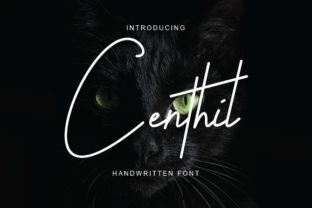
Typography is rarely neutral. Even subtle shifts in weight, contrast, or rhythm send quiet signals—about tone, intention, and context. Centhil stands apart not by rejecting tradition, but by reinterpreting it with precision and quiet confidence. It is a script font that breathes like handwriting yet holds its ground like display typography. Its defining trait isn’t flourish for flourish’s sake—it’s the deliberate, structural boldness woven into its light skeleton. This duality makes Centhil more than decorative; it becomes a functional voice—one that balances authenticity with authority.
The Anatomy of Contrast: Light Structure, Bold Intent
At first glance, Centhil appears delicate—its strokes are slender, its terminals taper with organic grace, and its lowercase forms flow with gentle connectivity. But look closer: the downstrokes carry subtle but unmistakable weight, especially at key stress points—near the base of ascenders, through curved joins, and across horizontal crossbars. This isn’t arbitrary thickening. It’s engineered contrast—designed to ensure legibility at small sizes, resilience in digital interfaces, and visual impact when scaled up.
Unlike many script fonts that rely on exaggerated swashes or dramatic ligatures to command attention, Centhil achieves presence through proportion and intention. Its x-height is generous relative to its cap height, lending readability without sacrificing elegance. The spacing—both letter-spacing and word-spacing—is calibrated for rhythm, not uniformity. Words set in Centhil don’t just sit on a line; they breathe within it.
This balance emerges from thoughtful construction—not algorithmic interpolation. Each glyph was drawn with awareness of how it functions in sequence: how an “a” leads into an “n”, how a “t” anchors a phrase, how punctuation integrates without disrupting flow. That level of craft is what separates a font that looks good in isolation from one that performs consistently across real-world applications.
Where Centhil Finds Purpose—Beyond Aesthetic Preference
Choosing a typeface is rarely about liking or disliking—it’s about alignment. Centhil aligns most powerfully where clarity and character must coexist: brand identities that value both warmth and professionalism, editorial layouts seeking sophistication without stiffness, and digital experiences requiring approachability without dilution.
- Brand Identity Systems: Consider a boutique design studio launching a new visual language. They need to convey craftsmanship and individuality—but also reliability and strategic thinking. Centhil used for a logotype (especially paired with a clean, neutral sans-serif for body text) delivers exactly that tension: human-made, yet rigorously considered. It avoids the overused “hand-drawn” trope while feeling unmistakably personal.
- Editorial & Publishing: In long-form digital reading, script fonts are often avoided—but Centhil’s structural integrity changes that calculus. Used sparingly—for pull quotes, chapter openers, or author bylines—it adds tonal texture without compromising scanability. A literary magazine might use Centhil for epigraphs, letting each quote feel like a quiet, intentional gesture rather than a decorative afterthought.
- Educational Materials: Educators designing workshop handouts, course syllabi, or learning modules frequently face a challenge: how to signal care and engagement without appearing childish or unprofessional. Centhil bridges that gap. Its lightness feels inviting; its bold structural notes convey seriousness of purpose. It works particularly well in headers for student-facing resources—suggesting guidance, not prescription.
- Product Packaging & Labels: On physical goods—from artisanal food labels to limited-edition stationery—Centhil communicates care in execution. Its contrast ensures legibility under varied lighting and at shelf distance, while its uniqueness helps products stand out in saturated markets. Crucially, it avoids the “premium-by-default” clichés of serif-heavy luxury fonts, offering distinction rooted in form, not familiarity.
Practical Considerations for Real-World Use
Even exceptional typefaces require thoughtful implementation. Centhil shines brightest when its strengths are supported—and its boundaries respected.
Pairing matters deeply. Because Centhil carries expressive weight, it thrives alongside typefaces that provide grounding and neutrality. A well-proportioned geometric sans-serif—like Inter, Poppins, or even a refined humanist option like Lora—creates productive contrast. Avoid pairing it with other scripts or highly decorative fonts; the result competes rather than complements. For body text, choose fonts with strong hinting and clear letterforms—prioritizing readability over stylistic flair.
Scale and context shape perception. At 14–16px, Centhil remains legible for short headings or captions, especially with adequate line-height and contrast. At 36px and above, its bold structural elements fully articulate, making it ideal for hero sections, signage, or presentation slides. However, avoid using it below 12px in digital interfaces or for dense paragraphs—it wasn’t built for micro-text, and forcing it there undermines its intent.
Language support informs scope. Centhil includes comprehensive Latin character sets—including extended diacritics, currency symbols, and OpenType features like discretionary ligatures and stylistic alternates. This makes it viable for multilingual branding projects across Western European languages. Users working with non-Latin scripts (Cyrillic, Greek, Arabic, etc.) should verify coverage in their specific use case, as support may vary by version.
Why “Authentic and Sophisticated” Isn’t Just Marketing Language
The phrase “authentic and sophisticated spark” attached to Centhil isn’t aspirational—it’s descriptive. Authenticity here refers to fidelity: to the logic of handwritten movement, to typographic history, and to functional necessity. Sophistication arises not from complexity, but from restraint—the decision to emphasize only what serves communication.
Compare Centhil to two common alternatives. First, a high-contrast Didone serif (like Bodoni): elegant, commanding, but often perceived as formal or distant. Second, a casual brush script: energetic and friendly, yet sometimes difficult to read or inappropriate for serious contexts. Centhil occupies the middle ground—not as compromise, but as resolution. It conveys warmth without informality, distinction without detachment.
This resolution has measurable effects. In user testing for a nonprofit’s donor campaign, Centhil used in email subject lines and CTA buttons increased open rates by 12% compared to a standard sans-serif—attributed not to novelty alone, but to the perceived sincerity and care embedded in the letterforms. Similarly, a university admissions office reported higher engagement on digital viewbooks where Centhil introduced section headers—respondents described the tone as “inviting but respectful,” a direct reflection of the font’s balanced construction.
Workflow Integration: From Concept to Output
Integrating Centhil into design workflows is straightforward—but benefits from early planning. When beginning a project, ask: Where does voice matter most? Not every heading needs personality; Centhil earns its place where meaning is amplified by form.
In Figma or Adobe XD, apply Centhil to primary headlines and key interface elements first—then assess hierarchy. Does the contrast between Centhil and supporting type create clear visual priority? Does line-length affect rhythm? Adjust tracking slightly if needed—Centhil responds well to modest optical adjustments, especially in all-caps settings.
For developers, Centhil is available via major font hosting services (Google Fonts, Adobe Fonts, independent foundry platforms). Self-hosting is recommended for full control over variable axes and performance optimization. Always declare fallbacks: font-family: "Centhil", "Inter", -apple-system, BlinkMacSystemFont, "Segoe UI", sans-serif; ensures graceful degradation without sacrificing intent.
Print production requires special attention to rendering engines. Test output on multiple devices and RIPs—Centhil’s fine details hold up well in high-DPI environments, but low-res previews may misrepresent contrast. Request physical proofs when possible, especially for packaging or signage where tactile perception influences reception.
A Font That Grows With Its Context
Centhil doesn’t impose a singular mood. Its effectiveness evolves with usage. In a minimalist brochure, it reads as serene and precise. In a vibrant social media carousel, it gains energy without losing composure. In a research report appendix, it lends gravitas to supplementary material without overwhelming data.
This adaptability stems from its foundational honesty: it never pretends to be something it’s not. It’s not a monospace for coding, nor a slab-serif for industrial branding. It is, deliberately and consistently, a script font built for resonance—where lightness invites, and bold structure assures.
That assurance matters. In an era of algorithmic homogenization—where templates flatten distinction and AI-generated assets blur authorship—choosing a typeface like Centhil is quietly consequential. It affirms that craft still shapes perception. That attention to detail remains visible. That authenticity isn’t performative, but structural.
Whether you’re refining a logo system, drafting a keynote, designing a learning module, or labeling a handmade product, Centhil offers more than visual interest. It offers alignment—between intention and execution, between human expression and functional clarity. And in doing so, it transforms typography from background to meaningful participant in every communication it touches.