Betterize: Bold, Urban Handwritten Font
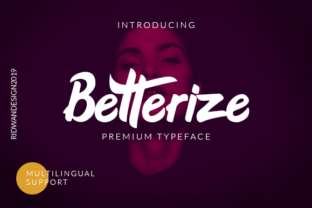
Imagine a font that doesn’t just sit on the page—it leans in, gestures, and adds attitude. Betterize is exactly that: a bold, dynamic handwritten typeface with an unmistakable urban twist. It’s not polished perfection—it’s confident imperfection, with energetic strokes, subtle irregularities, and intentional rhythm that feels human, immediate, and alive. Unlike many script fonts that prioritize elegance over energy, Betterize balances legibility with personality, making it equally at home on a streetwear label, a classroom poster, or a social media story.
What Makes Betterize Stand Out?
Betterize isn’t built for subtlety. Its thick-to-thin contrast is pronounced but controlled. Letters connect fluidly—yet never rigidly—so words flow like natural handwriting, not robotic cursive. The “urban twist” shows up in details: slightly angled baselines, unexpected exit strokes, and a grounded, no-nonsense stance that avoids looking overly playful or childish. It’s designed to be used at scale—large headlines, bold quotes, short slogans—but also holds up well in medium sizes for captions or callouts.
Technically, Betterize is a single-weight, OpenType font with standard Latin character support (A–Z, a–z, numerals, basic punctuation). It includes ligatures and alternate glyphs for visual variety—small touches that let you fine-tune tone without switching fonts. It’s not variable, nor does it come with dozens of stylistic sets—but that’s part of its strength. It’s focused, intentional, and ready to use right away.
For Designers & Brand Professionals
If you’re crafting a brand identity for a coffee roaster, indie record label, or creative studio, Betterize offers instant voice. It signals authenticity without leaning into cliché “hand-drawn” tropes. A designer might pair it with a clean sans-serif (like Inter or Poppins) for contrast—using Betterize for logos or hero text, then stepping back for readability in body copy. Speed matters here: no need to tweak kerning endlessly or hunt for alternate characters. It works out of the box—and clients often respond strongly to its warmth and confidence.
For Educators & Trainers
In classrooms or workshops, visual clarity and emotional resonance both matter. Betterize helps break up dense slides or handouts—not as body text, but as section headers, learning objectives, or motivational quotes. One middle school art teacher uses it for “Artist Spotlight” banners; students instantly recognize the style as “ours,” not “stock.” For educators evaluating fonts, legibility at a distance and ease of licensing (no subscription, one-time purchase) are practical priorities—Betterize checks both boxes.
For Small Business Owners & Marketers
You don’t have time to become a typography expert—but you *do* need visuals that reflect your energy. A food truck owner used Betterize on their chalkboard menu board and Instagram highlights. Why? Because it felt personal, not generic. It matched their vibe: fresh, unpretentious, rooted in real neighborhoods. For business owners, cost predictability matters—Betterize is a straightforward license, no recurring fees. And because it’s distinct but not distracting, it supports messaging instead of competing with it.
For Content Creators & Bloggers
On platforms where attention spans are short and visuals load first, Betterize gives thumbnails and quote graphics an edge. A wellness blogger overlays short affirmations in Betterize over neutral backgrounds—it stands out in feeds without screaming. She chooses it not for novelty, but for consistency: it reads clearly on mobile, scales well across formats (Stories, Pinterest pins, email headers), and reinforces her brand’s grounded, compassionate tone. For creators, flexibility across tools matters—Betterize works in Canva, Figma, Adobe apps, and even some web builders via @font-face.
For Beginners Exploring Design
If you’ve just opened Canva for the first time or installed your first desktop app, Betterize lowers the barrier. You don’t need to understand tracking, leading, or optical alignment to get good results. Type a headline. Adjust size. Done. Its built-in rhythm means even short phrases look considered—not awkward or lopsided. Beginners often gravitate toward fonts that “feel right” before they learn the rules—and Betterize rewards instinct. That said, it’s not ideal for long paragraphs or complex layouts. Knowing *where* it shines—and where to step back—is part of learning to use it well.
What It’s Not—And Why That’s Okay
Betterize isn’t a full-featured family with light, italic, or condensed variants. It won’t replace your system font for UI interfaces or legal disclaimers. It’s not optimized for screen reading or multilingual publishing beyond basic English. And if your project demands historical accuracy, calligraphic precision, or ultra-minimalist restraint, this isn’t the tool.
That narrow focus is intentional. It means Betterize excels where it’s meant to: adding humanity and presence to moments that benefit from a strong, expressive voice. It trades versatility for impact—so you’re not choosing *between* options, but choosing *for* purpose.
How to Know If Betterize Fits Your Next Project
Ask yourself a few simple questions:
- Is this for a headline, logo, poster, or short visual quote? → Yes? Betterize is likely a strong fit.
- Do you value immediacy over infinite customization? → Yes? Its straightforward design saves time.
- Does your brand or message lean into authenticity, creativity, or local character? → Yes? Its urban, handwritten energy aligns naturally.
- Are you working within tight deadlines or limited design resources? → Yes? It delivers consistent results without steep learning curves.
It’s less about “what can it do?” and more about “what does it help you say—and who will feel seen when they see it?” A nonprofit using Betterize on a community mural sign feels different than a tech startup using it on a launch banner—and that’s the point. The font adapts to context, not the other way around.
A Final Thought—Beyond Aesthetics
Typography isn’t just decoration. It’s how tone becomes tangible. Betterize invites a certain kind of engagement: direct, warm, unhurried. It asks viewers to pause—not because it’s ornate, but because it feels *meant*. That quality resonates differently depending on your role, your audience, and your goals. For a freelancer pitching a rebrand, it signals confidence. For a student designing a zine, it feels permission to be expressive. For a small café owner updating their chalkboard, it’s simply “more like us.”
If you’ve ever hesitated before choosing a font—wondering whether it’s “professional enough,” “friendly enough,” or “distinct enough”—Betterize offers a third option: one that’s human enough to connect, bold enough to be noticed, and grounded enough to last.