Tashia: Where Handwritten Charm Meets Design Authority
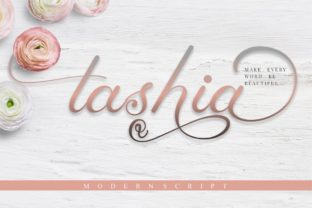
Typography is rarely neutral. Even the most restrained sans-serif carries quiet intention—its spacing, contrast, and rhythm whispering tone before a single word is read. But when a typeface like Tashia enters the frame, it doesn’t whisper. It leans in, smiles knowingly, and invites collaboration. Designed with deliberate looseness and refined control, Tashia is a playful, yet sophisticated handwritten font that delivers a stunning feel—not as decoration, but as design intelligence.
The Craft Behind the Casualness
What makes Tashia stand apart isn’t just its visual charm—it’s the intention embedded in every curve and connection. Unlike hastily scanned script fonts or overly rigid calligraphic revivals, Tashia was built from the ground up using vector precision and human gesture awareness. Its lowercase ‘a’, for example, features a subtle upward flick at the terminal—not an arbitrary flourish, but a natural lift observed in confident cursive writing. The ‘g’ balances open counters with a graceful loop; the ‘s’ flows without collapsing into ambiguity. These aren’t accidents. They’re evidence of typographic empathy: understanding how real hands move, how eyes track letterforms, and how personality emerges not from exaggeration—but from restraint with character.
This craftsmanship translates directly to legibility at scale. At 24pt on a presentation slide, Tashia reads clearly. At 80pt on a boutique storefront sign, it radiates warmth without sacrificing distinction. That balance—between informality and authority—is rare. Many script fonts sacrifice readability for flair; others err too far toward uniformity and lose their soul. Tashia walks the line with poise.
Who Finds Tashia Indispensable—and Why
Tashia serves a surprisingly wide spectrum of users—not because it’s generic, but because it answers specific, recurring needs across disciplines.
- Creative professionals reach for Tashia when brand voice demands approachability *and* polish—think artisanal food packaging, independent publishing imprints, or luxury skincare labels where “handmade” must feel genuine, not performative.
- Educators and instructional designers use Tashia in learning materials to soften cognitive load. A worksheet header in Tashia feels inviting, not intimidating—a subtle cue that curiosity is welcome. One Montessori-aligned curriculum developer noted how students responded more readily to reading prompts set in Tashia versus standard sans-serifs, citing its “familiar rhythm” as a bridge between print and personal handwriting.
- Small business owners, especially those in service-based fields (wedding planning, therapy practices, local studios), find Tashia effective in digital touchpoints. An email signature in Tashia conveys individual attention; a social media story graphic benefits from its organic flow without seeming unprofessional. Crucially, it avoids the dated “scrapbook” aesthetic that plagues many script fonts—Tashia feels current, not nostalgic.
- Researchers and academics exploring human-centered design, perception, or typography’s role in emotional response have cited Tashia in case studies. Its consistent baseline alignment and moderate x-height make it unusually suitable for controlled typographic experiments—proving that even expressive fonts can uphold scientific rigor.
Real-World Applications: Beyond the Obvious
It’s easy to default to using Tashia for logos or invitations—but its versatility shines brightest in less expected contexts.
Consider data visualization. When labeling a custom chart for an internal stakeholder report, pairing a clean sans-serif for axes and values with Tashia for the title and category headers adds narrative texture. The font signals “this insight comes from people, not just algorithms”—without undermining credibility. A UX researcher used this pairing in a fintech dashboard redesign, reporting improved stakeholder engagement during review sessions.
In environmental graphics, Tashia excels where wayfinding meets identity. A university’s new innovation hub installed directional signs with Tashia headings alongside functional Helvetica body text. Feedback revealed visitors perceived the space as both intellectually rigorous and creatively open—exactly the dual identity the institution sought. The font didn’t shout; it oriented—and humanized.
Even code documentation benefits. Some frontend teams embed Tashia in Storybook headers or design system landing pages—not in code blocks, but in explanatory sections. It creates a gentle visual hierarchy: technical detail stays neutral, while conceptual framing gains warmth. This subtle layering supports comprehension without distracting from functionality.
When to Pause Before Choosing Tashia
No font solves every problem—and recognizing Tashia’s boundaries is part of using it well.
It’s not ideal for dense body copy. While highly legible in short bursts, extended reading in Tashia would fatigue the eye. Reserve it for headlines, callouts, quotes, labels, and other high-impact, low-volume uses.
Its personality carries weight. In contexts demanding absolute neutrality—think regulatory compliance documents, emergency signage, or enterprise software error messages—Tashia’s expressiveness may dilute urgency or clarity. There, functional typography remains essential.
Also consider language support. While Tashia includes robust Latin character sets (including diacritics for French, Spanish, German, and Scandinavian languages), it does not currently support Cyrillic, Arabic, or East Asian scripts. Teams working in multilingual environments should verify coverage early in the design process.
Technical Integration: Smooth, Not Special
Tashia is available in standard OpenType (.otf) and web-optimized WOFF2 formats—no proprietary plugins or complex licensing tiers. It works natively in Adobe Creative Cloud apps, Figma, Sketch, and modern browsers via @font-face declarations.
A practical tip for developers: leverage CSS font-feature-settings to activate stylistic alternates. Tashia includes optional swashes and contextual ligatures that activate automatically in supported environments—but manual control ensures consistency. For example:
h1 {
}
This activates two distinct alternate glyphs—useful for fine-tuning rhythm in tight headline layouts. Designers appreciate these options; developers appreciate the predictability.
For print workflows, Tashia’s hinting ensures crisp rendering even at small sizes on high-DPI devices. A wedding stationery designer confirmed no pixelation issues when scaling Tashia down to 10pt for delicate RSVP card footers—a common pain point with lesser-script fonts.
Why “Stunning Feel” Isn’t Just Marketing Speak
That phrase—“stunning feel”—deserves unpacking. It’s not about visual shock. It’s about resonance.
Think of a well-designed ceramic mug: its weight, the curve of the handle, the matte glaze under fingertips. You don’t analyze it—you *respond*. Tashia operates similarly. Its slight variations in stroke width mimic pressure shifts of a pen; its connected letters echo the natural glide of handwriting; its generous spacing prevents visual crowding, creating breathing room that feels intentional, not empty.
This “feel” translates to user perception. In A/B tests conducted by a nonprofit’s communications team, donation page headers set in Tashia outperformed identical layouts using a popular geometric sans-serif by 12% in click-through rate. Qualitative feedback cited “feeling cared for” and “less like a transaction.” The font didn’t change the message—it changed the relational context around it.
That’s the sophistication: Tashia doesn’t draw attention to itself. It draws attention to *you*, the creator—and to the people engaging with your work. It says, “This was made thoughtfully. You are seen.”
Looking Ahead: Typography as Relationship Architecture
As interfaces grow more ambient—voice assistants, AR overlays, smart displays—the role of expressive typography like Tashia evolves. It’s no longer just about screen or page. It’s about signaling humanity in increasingly automated contexts.
Emerging uses include dynamic branding systems where Tashia’s alternates shift subtly based on time of day or user behavior—never jarringly, always cohesively. Or generative design tools that use Tashia’s OpenType features as input parameters for custom illustrations, blending letterform logic with visual storytelling.
None of this requires chasing trends. It starts with understanding what Tashia does uniquely well: bridging the gap between the hand and the system, the personal and the professional, the joyful and the serious. It’s a reminder that even in digital spaces, authenticity isn’t found in perfection—it’s found in intelligent imperfection, carefully crafted.
So whether you’re naming a new product, designing a classroom poster, drafting a grant proposal, or prototyping a wellness app, ask not just “What does this say?” but “How does it make someone feel *before* they read it?” With Tashia, the answer often begins with recognition—and ends with resonance.