Soulmate
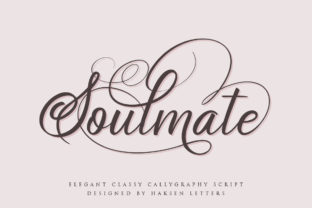
Handwritten fonts have long carried emotional weight—warmth, authenticity, personality—but few deliver both expressive energy and professional polish like Soulmate. It’s not just another script font. Soulmate is a fun and bold handwritten font with amazing swashes: confident curves, rhythmic contrast, and intentional imperfections that feel human—not hurried. Its design bridges the gap between casual charm and intentional craftsmanship, making it equally at home on a wedding invitation, a boutique skincare label, or a social media carousel meant to stop mid-scroll.
Why Handwritten Typography Is Resonating—Right Now
People aren’t rejecting digital tools—they’re redefining what “human-centered” means in visual communication. With AI-generated content flooding feeds and interfaces growing increasingly uniform, audiences are subconsciously gravitating toward signals of care, intention, and individuality. A well-chosen handwritten font like Soulmate acts as one of those signals: subtle but unmistakable. It doesn’t shout “handmade!”—it whispers “this was made for you.”
This isn’t nostalgia for analog; it’s responsiveness to real shifts. Consumers spend less time reading full captions and more time scanning visuals. In that split second, typography sets tone before a single word is processed. Soulmate’s bold baseline and generous swashes create immediate visual rhythm—guiding the eye, adding movement, and implying confidence without clutter.
From Decoration to Design Strategy
Five years ago, many designers reserved handwritten fonts for niche uses: greeting cards, café chalkboards, or whimsical logos. Today, they’re embedded into broader brand systems—not as accents, but as functional typographic anchors. Soulmate reflects this evolution. Its swashes aren’t ornamental afterthoughts; they’re carefully calibrated extensions of letterforms, designed to connect, balance, and scale gracefully across sizes and mediums.
Consider how a small business owner might use it: a local pottery studio chooses Soulmate for its Instagram story highlights—not just because it “looks artsy,” but because its vertical stress and open counters remain legible even at 32px on mobile. Or a freelance educator building an online course: pairing Soulmate’s headline treatment with a clean sans-serif body font creates hierarchy that feels approachable yet authoritative—no extra explanation needed.
Swashes That Serve—Not Just Style
What makes Soulmate’s swashes stand out isn’t their length or flourish alone—it’s their purposeful variation. Some letters feature entry swashes only; others offer exit swashes or both. Several include alternate glyphs that simplify or extend depending on context. This level of typographic control matters when designing for consistency across touchpoints: a logo lockup, email header, and product tag all benefit from nuanced, context-aware letterforms—not one-size-fits-all decoration.
Unlike many script fonts that collapse into illegibility at smaller sizes or lose impact in all-caps settings, Soulmate maintains clarity through intelligent spacing and balanced weight distribution. Its lowercase ‘g’, ‘y’, and ‘j’ anchor lines with grounded descenders, while uppercase ‘S’, ‘L’, and ‘T’ carry enough presence to function as standalone monograms or initials in branding applications.
Practical Integration Across Workflows
Modern creators rarely work in isolation. They toggle between Figma and Canva, export assets for web and print, and collaborate across time zones. Soulmate supports these realities—not just technically (with OpenType features, cross-platform compatibility, and variable weight options where applicable), but conceptually. Its versatility reduces the need to juggle multiple fonts to achieve tonal range.
- For marketers: Use Soulmate’s headline variant in animated email banners—its strong x-height ensures readability even when compressed into tight layouts.
- For educators: Apply its swash-heavy alternates sparingly in slide headers to reinforce key themes—like “connection” or “creativity”—without overwhelming learning content.
- For freelancers: Build a simple brand kit around Soulmate + one neutral sans-serif. Clients immediately recognize cohesion, and you save hours choosing fonts per project.
- For small business owners: Print Soulmate on kraft paper packaging—it gains texture and tactility without sacrificing legibility, reinforcing artisan values authentically.
Designing With Intention—Not Just Aesthetic
Choosing Soulmate isn’t about chasing trendiness—it’s about aligning visual language with message intent. A fintech startup wouldn’t use it for regulatory disclosures, nor should it. But that same company might deploy Soulmate thoughtfully in a customer onboarding email series: warm, encouraging, and human-scaled—contrasting intentionally with the precision of its interface typography.
This kind of strategic layering reflects how professionals are thinking more holistically about typography today. Fonts aren’t just “pretty” or “professional”—they’re tools for emotional calibration. Soulmate excels where warmth and clarity must coexist: service-based brands, wellness offerings, creative workshops, community-driven platforms, and mission-led ventures.
Evolving Beyond “Cute” or “Casual”
Historically, handwritten fonts carried baggage—associated with craft fairs, kindergarten worksheets, or dated “mompreneur” aesthetics. Soulmate sidesteps those assumptions by balancing playfulness with structural integrity. Its contrast ratio meets WCAG guidelines for text use at larger sizes, and its letter spacing avoids the cramped density that plagues many script fonts in digital contexts.
That evolution mirrors broader cultural shifts: authenticity no longer means “unpolished”—it means “intentionally crafted.” Think of chefs who post behind-the-scenes reels not to show chaos, but to reveal process and care. Soulmate operates similarly: it looks effortless, but every curve and connection has been tested for flow, rhythm, and real-world usability.
Getting Started—Without Overcomplicating
You don’t need advanced typography training to use Soulmate effectively. Start simple: pick one high-impact application—a logo lockup, hero section headline, or signature email footer—and apply it there first. Observe how it changes perception. Does it soften tone? Add memorability? Invite closer attention?
Then expand deliberately. Try pairing it with a neutral, highly legible sans-serif (think Inter, Poppins, or Manrope) for body copy. Avoid stacking multiple decorative fonts—Soulmate carries enough presence on its own. If using swashes, limit them to initial letters or key words (“You,” “Now,” “Together”) rather than entire phrases. Let the font breathe.
And remember: typography works best when it serves people—not trends. If Soulmate helps your audience feel seen, understood, or welcomed in a crowded space, then it’s doing its job. That’s not stylistic flair. It’s functional empathy.
A Font That Grows With You
Soulmate isn’t frozen in a single moment of design history. Its structure accommodates evolving needs—whether you’re designing for dark mode interfaces (where its contrast shines), voice-assisted previews (where clear letterforms improve screen reader parsing), or multilingual projects (with extended Latin character support). It adapts because it was built with flexibility in mind—not just aesthetic variety.
As workflows grow more hybrid, audiences grow more discerning, and attention grows more fragmented, tools like Soulmate gain quiet importance. They don’t solve business problems alone—but they help make solutions feel more human, more trustworthy, and more worth noticing.