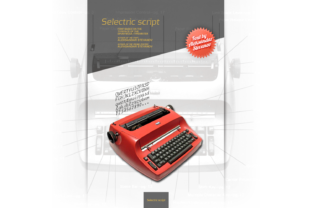
Selectric Script: The Timeless Typewriter-Handwritten Hybrid Font
Have you ever seen a logo, wedding invitation, or vintage-inspired poster that felt both nostalgic and personal—like it was typed on an old office machine yet signed by hand? Chances are, you were looking at Selectric Script. This distinctive typeface bridges two beloved visual worlds: the mechanical charm of mid-century typewriters and the warmth of human handwriting. More than just a stylistic curiosity, Selectric Script holds enduring relevance for designers, marketers, educators, and everyday creators seeking authenticity in digital spaces.
What Is Selectric Script—and Where Did It Come From?
Selectric Script is a classic script font released in 1960 by International Typeface Corporation (ITC), designed by Ray Larabie (in later revivals) and originally inspired by IBM’s Selectric typewriter—a groundbreaking office machine introduced in 1961. Unlike traditional typewriters with fixed character bars, the Selectric used a rotating, golf-ball-shaped type element that allowed for interchangeable fonts—including a cursive “Script” ball.
The digital version we use today captures the essence of that physical typeball: uneven baseline alignment, subtle variations in stroke weight, and slight inconsistencies in letter spacing and slant. These aren’t flaws—they’re intentional design choices meant to mimic how a real typewriter might render handwritten-style characters under imperfect mechanical conditions.
Why It Feels “Real” (and Why That Matters)
Unlike many modern script fonts—some overly smooth, others excessively ornate—Selectric Script strikes a rare balance. Its letters have organic rhythm, not robotic precision. A lowercase “a” may sit slightly higher than its neighbor; an “s” might taper more sharply on one side. These micro-variations echo human imperfection, triggering subconscious associations with sincerity, craft, and individuality.
This psychological resonance explains why Selectric Script remains popular across contexts where trust and approachability matter—from boutique coffee shop signage to handmade soap labels and indie podcast branding. In an age of algorithmically generated content and AI-designed visuals, fonts like Selectric Script offer a tactile, human counterpoint.
How Selectric Script Fits Into Modern Design & Communication
Despite its retro roots, Selectric Script isn’t confined to throwback projects. Its versatility shines when used thoughtfully alongside contemporary tools and trends:
- Branding with personality: Small businesses leverage Selectric Script to convey friendliness without sacrificing professionalism—think a local bookstore’s newsletter header or a therapist’s website “About Me” section.
- Educational materials: Teachers use it sparingly in classroom handouts or digital slides to highlight key concepts, making information feel more conversational and less intimidating for younger learners.
- Social media storytelling: On platforms like Instagram or Pinterest, short quotes set in Selectric Script stand out amid sleek sans-serif feeds—especially when paired with warm-toned photography or textured backgrounds.
- Print-on-demand products: From greeting cards to custom notebooks, this font adds artisanal credibility to mass-produced items, helping independent sellers differentiate their offerings.
Importantly, Selectric Script works best when applied with restraint. Because it’s inherently expressive, overuse can dilute impact—or unintentionally signal informality where clarity is needed (e.g., legal disclaimers or technical documentation).
Common Misconceptions About Selectric Script
Before incorporating Selectric Script into your next project, it helps to clear up a few frequent misunderstandings:
- “It’s just a ‘typewriter font.’” Not quite. While it shares lineage with typewriter aesthetics, Selectric Script is specifically modeled after the cursive typeball—a rarer, more expressive variant than standard monospaced typewriter fonts like Courier.
- “It’s only for vintage designs.” False. When combined with minimalist layouts, bold color blocking, or modern photography, Selectric Script gains fresh energy—not datedness.
- “It’s hard to read at small sizes.” Yes—so don’t use it for body text or fine print. But that limitation is part of its strength: it guides attention toward headlines, callouts, and signature moments.
- “All versions are the same.” They’re not. Free downloads often lack OpenType features like ligatures or alternate characters. Professional versions (such as those from Adobe Fonts or commercial foundries) include expanded language support, improved kerning pairs, and stylistic sets for nuanced control.
Practical Tips for Using Selectric Script Effectively
Whether you're designing a business card or drafting a presentation slide, these guidelines help maximize Selectric Script’s impact while maintaining readability and brand coherence:
- Pair it wisely: Contrast is key. Combine Selectric Script with clean, neutral sans-serifs (e.g., Inter, Helvetica Neue, or Montserrat) to let its character shine without visual competition.
- Respect hierarchy: Use it exclusively for primary headings, logos, or short accent phrases—not paragraphs, captions, or navigation menus.
- Adjust tracking deliberately: Slightly increased letter spacing (5–10 units in design software) often improves legibility, especially at larger sizes.
- Test across devices: Rendering varies between operating systems. Preview how it appears on mobile screens, email clients, and PDF exports before finalizing.
- Consider licensing: Many free versions are intended for personal use only. For client work or commercial products, verify usage rights—or invest in a licensed version to ensure legal compliance and typographic quality.
Why Selectric Script Endures in a Digital-First World
In the broader story of typography, Selectric Script represents something quietly revolutionary: a celebration of imperfection as intention. At a time when digital tools push toward flawless uniformity—auto-aligned grids, AI-generated layouts, pixel-perfect symmetry—fonts like this remind us that connection often lives in the irregular, the slightly off-kilter, the human-made.
Its staying power also reflects deeper cultural shifts. Consumers increasingly favor brands that feel genuine over those that feel polished. Students respond better to learning materials that avoid sterile formality. Even in tech-forward industries—from fintech dashboards to health apps—designers are integrating warmer, more tactile elements to reduce cognitive load and build emotional resonance.
Selectric Script doesn’t ask you to reject modernity. Instead, it invites you to enrich it—with history, humility, and hand-crafted nuance.
A Final Thought: Typography as Quiet Storytelling
Every font carries a whisper of context: where it was born, who used it first, what values it subtly reinforces. Selectric Script whispers of clacking keys in quiet offices, of secretaries typing love letters between memos, of designers in smock-covered studios experimenting with ink and metal. Today, that whisper translates into something equally meaningful: care.
When you choose Selectric Script—not as a gimmick, but as a considered voice—you’re signaling that the message matters enough to be delivered with warmth, intention, and a touch of soul. And in a world saturated with noise, that kind of quiet distinction is anything but outdated.
Ready to explore further? Learn more about Selectric Script on Adobe Fonts or discover complementary type pairings in our free typography pairing guide.