Natthalie Font
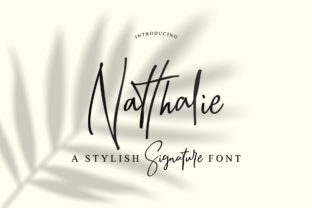
Natthalie is a handwritten typeface designed to convey lightness, casual elegance, and subtle sophistication. It is not a script font in the traditional sense—there are no dramatic flourishes or exaggerated connections between letters. Instead, Natthalie features relaxed letterforms, gentle contrast in stroke weight, and an intentionally airy rhythm that evokes natural handwriting without sacrificing legibility.
What Makes Natthalie Distinctive?
Unlike many handwritten fonts that prioritize expressiveness over utility, Natthalie balances personality with practicality. Its lowercase letters have soft entry and exit strokes, modest x-height, and consistent spacing that supports readability at moderate sizes. Uppercase characters retain a hand-drawn quality but avoid excessive irregularity—making them more versatile for branding applications than highly idiosyncratic alternatives.
The font includes standard Latin characters, numerals, and basic punctuation. It does not support extended language sets (e.g., Cyrillic or Vietnamese), nor does it include stylistic alternates, swashes, or contextual ligatures. This intentional minimalism contributes to its clean aesthetic but also defines its functional scope.
When Might Natthalie Be a Good Fit?
Natthalie works well in contexts where tone matters as much as information. Designers often choose it for projects requiring approachability without informality—such as boutique packaging, wedding stationery, lifestyle blog headers, or artisanal product labels. Its light texture pairs effectively with ample white space and restrained color palettes, reinforcing a sense of calm refinement.
Because of its low visual density, Natthalie performs best at larger sizes: headlines, short quotes, or logo lockups. It remains legible down to ~24–28px in digital interfaces and ~10–12pt in print—but only when used sparingly and with generous line spacing. It is not intended for body text, long paragraphs, or dense UI elements.
Key Benefits to Consider
- Distinctive yet restrained: Offers character without overwhelming design hierarchy.
- Light visual weight: Complements minimalist layouts and avoids competing with imagery or photography.
- Consistent rhythm: Even spacing and predictable letter proportions simplify alignment and scaling across formats.
- Neutral warmth: Feels personal but not overly playful—suitable for audiences spanning young adults to mature consumers.
Tradeoffs and Limitations
Its lightness is both a strength and a constraint. In environments with low contrast—such as light gray text on white backgrounds or projected presentations—Natthalie can appear faint or indistinct. Similarly, on lower-resolution screens or in small UI components (e.g., buttons or captions), its fine details may blur or disappear.
Because Natthalie lacks optical sizing variants or multiple weights, designers must rely on external adjustments—like tracking, line height, or color contrast—to achieve balance. It does not scale predictably across responsive breakpoints without manual tuning.
Also, while its casual nature invites creativity, it can unintentionally undermine authority in formal contexts. Legal disclaimers, academic publications, corporate reports, or technical documentation typically require higher legibility and structural neutrality—areas where Natthalie’s expressive qualities become liabilities rather than assets.
Situations Where Alternatives May Be More Appropriate
If your project demands high readability at small sizes—such as mobile app interfaces, data dashboards, or instructional materials—a sans-serif like Inter, Manrope, or IBM Plex Sans will offer better performance. These fonts include robust hinting, expanded character sets, and multiple weights optimized for screen use.
For branding requiring strong personality *and* versatility, consider hybrid options like Proza Libre (a humanist sans with organic warmth) or Shantel (a friendly, slightly handwritten sans). These maintain voice while supporting broader typographic roles—from headlines to footnotes.
If you need true script functionality—such as connected cursive, variable stroke modulation, or multilingual support—fonts like Great Vibes, Parisienne, or Quicksand (for a softer, rounded alternative) may align more closely with those goals—even if they sacrifice some of Natthalie’s subtlety.
Practical Decision-Making Guidance
Before selecting Natthalie, ask yourself three questions:
- What is the primary role of the text? If it’s decorative, emotional, or hierarchical (e.g., a headline introducing a brand story), Natthalie’s strengths shine. If it’s functional, navigational, or informational (e.g., navigation labels, form fields, or instructions), test alternatives first.
- Where and how will it be seen? Review real-world usage scenarios: screen resolution, ambient lighting, viewing distance, and expected duration of exposure. A font that looks elegant on a printed invitation may fail on a smartphone menu.
- What other typefaces are in the system? Natthalie pairs best with neutral, open-sans or geometric sans-serifs (e.g., Work Sans, Montserrat, or Open Sans). Avoid pairing it with other handwritten or high-contrast fonts, which can create visual competition or tonal inconsistency.
Testing and Implementation Tips
When evaluating Natthalie for a specific use case, simulate real conditions—not just ideal ones. Render it in your actual layout software at intended sizes, using target colors and backgrounds. Print samples if the output will be physical. Check contrast ratios against WCAG guidelines, especially for accessibility-critical text.
Consider licensing early. Natthalie is available under standard desktop, web, and app licenses, but usage rights vary by vendor. Some versions include only basic OpenType features; others may offer variable axes (e.g., weight or width) if released as a variable font—verify specifications before purchase or download.
Finally, remember that typography serves communication—not aesthetics alone. Natthalie excels when its light, unhurried presence reinforces a message of calm intentionality. It is less effective when clarity, speed of comprehension, or broad compatibility take priority.
Ultimately, choosing Natthalie is not about whether it’s “good” in absolute terms—it’s about whether its particular blend of ease, elegance, and restraint matches the needs of your audience, medium, and message.