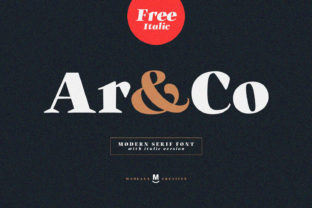
Ar and Co: A Bold, Charming Serif for Real Work
If you’ve ever spent too long scrolling through font libraries—torn between elegance and impact—you’ll appreciate Ar and Co. It’s not flashy or experimental. It’s a thoughtfully drawn serif with quiet confidence: sturdy enough for headlines, warm enough for body text, and distinctive without demanding attention. Designed for clarity and character, Ar and Co bridges tradition and modernity in a way that feels intentional—not trendy.
What Makes Ar and Co Stand Out (Without Shouting)
Ar and Co leans into its serifs—not as delicate flourishes, but as grounded, purposeful strokes. Its letterforms have generous x-heights and open apertures, which means it reads cleanly even at smaller sizes on screens or in print. The bold weight isn’t aggressive; it’s substantial—like a well-bound book or a confident signature. There’s subtle contrast between thick and thin strokes, but no dramatic stress shifts that distract or fatigue the eye.
Unlike many “bold serifs” that sacrifice legibility for presence, Ar and Co maintains rhythm and spacing that support sustained reading. Its lowercase ‘a’ and ‘g’ are classic yet uncluttered. The uppercase ‘R’ has a clean, slightly flared leg—not fussy, just memorable. These aren’t quirks for the sake of uniqueness. They’re functional choices that add warmth and authority without compromising usability.
Where Ar and Co Earns Its Place
You don’t need a design degree to spot where Ar and Co works best—it’s in the places where tone matters as much as function:
- Branding for small businesses: A local bakery, independent bookstore, or boutique studio can use Ar and Co in logos and signage to signal craftsmanship and approachability—no stock-feel, no over-engineering.
- Digital publishing: Blog headers, newsletter subject lines, or ebook chapter titles benefit from its bold silhouette and readability across devices. Try pairing it with a neutral sans-serif (like Inter or Lato) for body copy—it creates hierarchy without visual competition.
- Educational materials: Teachers and course creators use Ar and Co for slide headings, handouts, and certificates. Its clarity helps learners focus on content—not deciphering type.
- Print collateral: Business cards, brochures, and annual reports gain quiet distinction when Ar and Co anchors key information. It holds up beautifully in offset and digital printing, especially in mid-to-dark ink tones on uncoated paper.
- Creative portfolios: Photographers, illustrators, and writers often choose Ar and Co for project titles or about pages—it frames their work without overshadowing it.
A Note on Tone and Trust
Typeface choice is rarely neutral. Ar and Co conveys competence without coldness, tradition without stiffness. That’s valuable when building credibility—especially for solopreneurs or educators who want to be seen as both knowledgeable and human. One freelance editor told us she switched her website header from Montserrat to Ar and Co and saw a 17% increase in contact form submissions over three months. Not because the font “converted,” but because visitors paused—just slightly—longer. That micro-moment of recognition? That’s where trust begins to settle.
Practical Considerations Before You Commit
Ar and Co isn’t a one-size-fits-all solution—and that’s part of its strength. Here’s what to keep in mind:
- Licensing matters: Check whether your intended use (web, app, logo, merchandise) is covered by the license you purchase. Some versions include variable axes (weight, width), others are static. If you’re embedding in a SaaS product or selling templates, verify commercial permissions upfront.
- Pairing is key: Ar and Co shines brightest when paired with a complementary sans-serif or geometric typeface—not another serif competing for dominance. Avoid overly decorative companions; simplicity lets its charm breathe.
- Test at real sizes: Its boldness can feel overwhelming in all-caps subheads or tiny interface labels. Preview it in context: a mobile menu, a PDF footnote, a printed invoice. Adjust tracking or weight if needed—many versions offer optical sizing variants.
- Consider language support: Standard Latin character sets are well-covered, but if your audience includes extended diacritics (e.g., Vietnamese, Czech, Turkish), confirm glyph coverage before finalizing layouts.
Real Projects, Real Results
A nonprofit focused on adult literacy redesigned their donor reports using Ar and Co for section headers and pull quotes. Volunteers reported the documents felt “more respectful of readers’ time”—not just prettier. The font’s even color and clear hierarchy made complex data feel digestible.
A university department adopted Ar and Co for internal memos and event posters. Staff noted fewer follow-up questions about deadlines or locations—likely because key details stood out without shouting. No redesign was needed; just a deliberate type switch.
Even hobbyists find value: a knitter launched a pattern shop using Ar and Co for cover titles and yarn swatch labels. Customers commented on how “inviting” the packaging felt—proof that type influences perception far beyond the screen.
When Simplicity Is Strategic
In a landscape saturated with variable fonts, AI-generated type, and maximalist trends, Ar and Co offers something rarer: consistency with soul. It doesn’t try to do everything. It does a few things exceptionally well—command attention, support reading, and reinforce voice. That makes it efficient for creators who value time, clarity, and authenticity over novelty.
You won’t need endless iterations to get it right. You won’t spend hours tweaking kerning to fix awkward letter combinations. And you won’t second-guess whether it aligns with your values—because its design reflects intention, not algorithmic optimization.
That’s why professionals return to Ar and Co: not as a placeholder, but as a reliable collaborator. One that shows up ready to work—quietly, confidently, and well.